MCQ
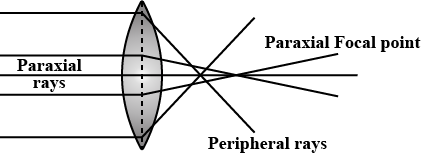
The rays parallel and close to the principal axis are called:
- AConverging rays
- BDiverging rays
- CCoherent rays
- DParaxial rays
The rays parallel and close to the principal axis are called:
Explanation:
The rays parallel and close to the principal axis are called paraxial rays. The rays parallel but not close to the principal axis are called peripheral rays.
Generate a complete, print-ready paper with questions like this in minutes — across 16+ boards, with answer keys.
In image formation from spherical mirrors, only paraxial rays are considered because they:
In Young’s double slit experiment, the aperture screen distance is 2m. The fringe width is 1 mm. Light of 600 nm is used. If a thin plate of glass (m = 1.5) of thickness 0.06 mm is placed over one of the slits, then there will be a lateral displacement of the fringes by
|
(a) 0 cm |
(b) 5 cm |
(c) 10 cm |
(d) 15 cm |
Thermal neutrons are those which
|
(a) Are at very high temperature |
|
(b) Move with high velocities |
|
(c) Have kinetic energies similar to those of surrounding molecules |
|
(d) Are at rest |
A radioactive element emits 200 particles per second. After three hours 25 particles per second are emitted. The half life period of element will be
|
(a) 50 minutes |
(b) 60 minutes |
(c) 70 minutes |
(d) 80 minutes |
The electric potential at a point (x, y) in the x - y plane is given by V = -kxy. The field intensity at a distance r from the origin varies as
|
(a) |
(b) r |
(c) |
(d) |
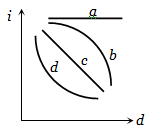
A point source of light is used in an experiment on photoelectric effect. Which of the following curves best represents the variation of photo current (i) with distance (d) of the source from the emitter
|
(a) a |
(b) b |
(c) c |
(d) d |
For goldplating on a copper chain, the substance required in the form of solution is
|
(a) Copper sulphate |
(b) Copper chloride |
|
(c) Potassium cyanide |
(d) Potassium aurocyanide |


