MCQ
The reaction $\ce{2A(g)\rightarrow A2​(g)},$ will be spontaneous :
  • A
    At high temperature
  • At low temperature
  • C
    At all temperature
  • D
    Never at any temperature

Answer

Correct option: B.
At low temperature

Need a full question paper?

Generate a complete, print-ready paper with questions like this in minutes — across 16+ boards, with answer keys.

Start Generating Free

Similar questions

Which one of the following compounds does not form an ozonide
The enthalpy change at $298\,K$ for decomposition is given in the following two steps

Step $I\,\,:$ ${H_2}O(g)\, \to \,H(g)\, + \,OH(g)\,;$              $\Delta H = 498\,kJ\,mol^{-1}$

Step $II\,\,:$ $OH(g)\, \to \,H(g)\, + \,O(g)\,;$              $\Delta H = 428\,kJ\,mol^{-1}$

The bond enthalpy of the $O-H$ bond is....$kJ\,mol^{-1}$

What will be the correct order of vapour pressure of water, acetone and ether at $30^\circ C$. Given that among these compounds, water has maximum boiling point and ether has minimum boiling point?
The densities of graphite and diamond at $298\, K$  are $2.25 $ and $3.31 \,g \,cm^{-3}$ respectively. If the standard free energy difference $(\Delta {G^o})$ is equal to $1895 \,J$ $mo{l^{ - 1}}$, the pressure at which graphite will be transformed diamond at $298\, K$  is
The number of $2-$ centre $-2-$ electron and $3-$ centre $-2-$ electron bonds in $B_2H_6$, respectively, are
Reaction, ${H_2}(g) + {I_2}(g) \to 2HI(g)$ $\Delta H = - 12.40\,kcal$. According to this, the heat of formation of $ HI $ will be......$kcal$
The largest no. of molecules are in
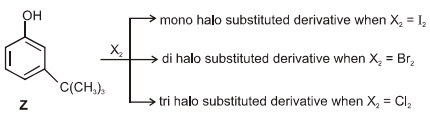
The reactivity of compound $Z$ with different halogens under appropriate conditions is given below :

$Image$

The observed pattern of electrophilic substitution can be explained by

$(A)$ the steric effect of the halogen

$(B)$ the steric effect of the tert-butyl group

$(C)$ the electronic effect of the phenolic group

$(D)$ the electronic effect of the tert-butyl group
Chemistry is sometimes called as :
Benzene can react with