MCQ
The reaction for which ${K_c} \leq {K_p}$ at $298\ K$
  • A
    $3{O_2}(g) \rightleftharpoons 2{O_3}(g)$
  • B
    ${N_2}(g) + 3{H_2}(g) \rightleftharpoons 2N{H_3}(g)$
  • C
    ${N_2}(g) + 2N{O_2}(g) \rightleftharpoons 2N{O_2}(g)$
  • ${H_2}(g) + {I_2}(g) \rightleftharpoons 2HI(g)$

Answer

Correct option: D.
${H_2}(g) + {I_2}(g) \rightleftharpoons 2HI(g)$
d

Need a full question paper?

Generate a complete, print-ready paper with questions like this in minutes — across 16+ boards, with answer keys.

Start Generating Free

Similar questions

In a chemical reaction, a reductant
If for a given substance melting point is ${T_B}$ and freezing point is ${T_A}$, then correct variation shown by graph between entropy change and temperature is
On adding $0.1\, M$ solution each of $[Ag^+], [Ba^{2+}], [Ca^{2+}]$ in a $Na_2SO_4$ solution, species first precipitated is $[K_{sp}\, BaSO_4 = 10^{-11}, K_{sp}\, CaSO_4 = 10^{-6}, K_{sp}\,Ag_2SO_4 = 10^{-5}]$
The atomic orbitals are progressively filled in order of increasing energy. This principle is called as
Which one of the following molecules is paramagnetic?
Match List $I$ with List $II$

List-$I$ (Compound) List-$II$ (Colour)
$A$ $\mathrm{Fe}_4\left[\mathrm{Fe}(\mathrm{CN})_6\right]_3 \cdot \mathrm{xH}_2 \mathrm{O}$ $I$ Violet
$B$ $\left[\mathrm{Fe}(\mathrm{CN})_5 \mathrm{NOS}\right]^{4-}$ $II$ Blood Red
$C$ $[\mathrm{Fe}(\mathrm{SCN})]^{2+}$ $III$ Prussian Blue
$D$ $\left(\mathrm{NH}_4\right)_3 \mathrm{PO}_4 \cdot 12 \mathrm{MoO}_3$ $IV$ Yellow

Choose the correct answer from the options given below :

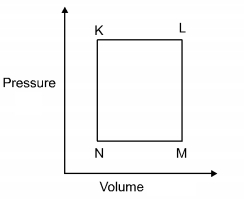
A fixed mass ' $m$ ' of a gas is subjected to transormation of states from $K$ to $L$ to $M$ to $N$ and back to $K$ as shown$Image$

$1.$ The succeeding operations that enable this transformation of states are

$(A)$ Heating, cooling, heating, cooling

$(B)$ Cooling, heating, cooling, heating

$(C)$ Heating, cooling, cooling, heating

$(D)$ Cooling, heating, heating, cooling

$2.$ The pair of isochoric processes among the transormation of states is

$(A)$ $K$ to $L$ and $L$ to $M$

$(B)$ $L$ to $M$ and $N$ to $K$

$(C)$ $L$ to $M$ and $M$ to $N$

$(D)$ $M$ to $N$ and $N$ to $K$

Give the answer question $1$ and $2.$
$600\,mL$ of $0.01\,M\,HCl$ is mixed with $400\,mL$ of $0.01\,M\,H _2 SO _4$. The $pH$ of the mixture is $.......\times 10^{-2}$. (Nearest integer) [Given $\log 2=0.30, \quad \log 3=0.48$ $\log 5=0.69 \quad \log 7=0.84$ $\log 11=1.04]$
Which one of the following combination represents a metallic element
The $pH$ of $0.1\,\,M$ solution of the following salts increases in the order