In order to increase the resistance of a given wire of uniform cross section to four times its value, a fraction of its length is stretched uniformly till the full length of the wire becomes $\frac{3}{2}$ times the original length what is the value of this fraction?
Advanced
Download our app for free and get started
Let, the length of wire $=l$ unit Fraction required $=a$
Then, the lenght of wire which is stretched $=a l$ $R_{l}=R_{(w i r e)}=\frac{\rho l}{A}$
$R_{l-a l}=\frac{\rho(l-a l)}{A}=R_{l(1-a)}$
$R_{a l}=\frac{\rho a l}{A}=a R_{l}$
On stretching $'al'$ length of wire, new length of $^{\prime} a l^{\prime}$ part$:$
$l-a l+l^{\prime}=\frac{3 l}{2}$
$l^{\prime}=l\left(\frac{1}{2}+a\right)$
Volume of wire $' a l^{\prime}$ is same$:$
$l^{\prime} A^{\prime}=(a l) A$
$l\left(\frac{1}{2}+a\right) A^{\prime}=(a l) A$
$A^{\prime}=\frac{a A}{\left(\frac{1}{2}+a\right)}$
Now, resistance of stretched parts,
$R^{\prime}=\frac{\rho \times l^{\prime}}{A^{\prime}}=\frac{\rho \times l\left(\frac{1}{2}+a\right)}{\frac{a A}{\frac{1}{2}+a}}=\frac{\rho l}{A} \frac{\left(\frac{1}{2}+a\right)^{2}}{a}$
$\Rightarrow R^{\prime}=\frac{R_{l}\left(\frac{1}{2}+a\right)^{2}}{a}$
According to the question,
$R_{l-a l}+R^{\prime}=4 R_{l}$
$\Rightarrow R_{l(1-a)}+R_{l} \frac{\left(\frac{1}{2}+a\right)^{2}}{a}=4 R_{l}$
$\Rightarrow a-a^{2}+\frac{1}{4}+a^{2}+a=4 a$
$\Rightarrow \frac{1}{4}+2 a=4 a$
$\Rightarrow \frac{1}{4}=4 a-2 a$
$\Rightarrow \frac{1}{4}=2 a$
$\Rightarrow a=\frac{1}{8}$

Download our appand get started for free
Experience the future of education. Simply download our apps or reach out to us for more information. Let's shape the future of learning together!No signup needed.*
Similar Questions
- 1The length of a wire of a potentiometer is $100\, cm$, and the $emf$ of its standard cell is $E\,volt$. It is employed to measure the $e.m.f$ of a battery whose internal resistance is $0.5 \,\Omega$. If the balance point is obtained at $l = 30\, cm$ from the positive end, the $e.m.f.$ of the battery isView Solution
where $i$ is the current in the potentiometer
- 2Two metal wires of identical dimensions are connected in series. If $\sigma _1$ and $\sigma _2$ are the conductivities of the metal wires respectively, the effective conductivity of the combination isView Solution
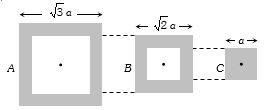
- 3Following figure shows cross-sections through three long conductors of the same length and material, with square cross-section of edge lengths as shown. Conductor $B$ will fit snugly within conductor $A$, and conductor $C$ will fit snugly within conductor $B$. Relationship between their end to end resistance isView Solution
- 4The charge flowing through a resistance $R$ varies with time $t$ as $ Q=at-bt^2 $ where $a$ and $b$ are positive constants . The total heat produced in $R$ isView Solution
- 5View SolutionOn increasing the temperature of a conductor, its resistance increases because
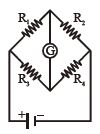
- 6The resistances in $WSB$ circuit shown in the diagram all are different and the current through the galvanometer is zero. If all thermal effects are negligible, the current through the galvanometer will not be zero, whenView Solution
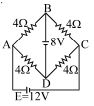
- 7The given figure shows $a$ network of resistances and $a$ battery. Which of the two batteries is getting charged?View Solution
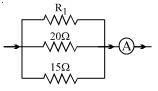
- 8In the given circuit the current flowing through the resisitance $20$ $\mathrm{ohms}$ is $0.3$ $\mathrm{ampere}$ while the ammeter reads $0.8$ $\mathrm{ampere}.$ What is the value of $R_1$? ................ $\mathrm{ohm}$View Solution
- 9An electrical bulb rated $220\,V , 100\,W$, is connected in series with another bulb rated $220\,V$, $60\,W$.If the voltage across combination is $220\,V$, the power consumed by the $100\,W$ bulb will be about $........... W$View Solution
- 10As shown in the figure, a potentiometer wire of resistance $20\,\Omega$ and length $300\,cm$ is connected with resistance box (R.B.) and a standard cell of emf $4\,V$. For a resistance ' $R$ ' of resistance box introduced into the circuit, the null point for a cell of $20\,mV$ is found to be $60\,cm$. The value of ' $R$ ' is $.....\Omega$View Solution