MCQ
The real image formed by a concave mirror is smaller than the object if the object is:
  • A
    Between centre of curvature and focus.
  • B
    At a distance greater than radius of curvature.
  • C
    At a distance equal to radius of curvature.
  • D
    At a distance equal to focal length.

Answer

  1. At a distance greater than radius of curvature.

Explanation:

The reason being, the image formed by a concave mirror is virtual, erect and magnified. The position of the object is between the pole and the focus.

Need a full question paper?

Generate a complete, print-ready paper with questions like this in minutes — across 16+ boards, with answer keys.

Start Generating Free

Similar questions

A convex lens has a focal length of 10cm. At which of the following position should an object be placed so that this convex lens may act as a magnifying glass?
A ray of light strikes a plane mirror PQ at an angle of incidence of 30°, is reflected from the plane mirror and then strikes a second plane mirror QR placed at right angles to the first mirror. The angle of reflection at the second mirror is:
A 3-pin mains plug is fitted to the cable for a 1 kW electric kettle to be used on a 250 V a.c. supply. Which of the following statements is not correct?
Each electrical appliance is provided with a _______ core flexible cable:
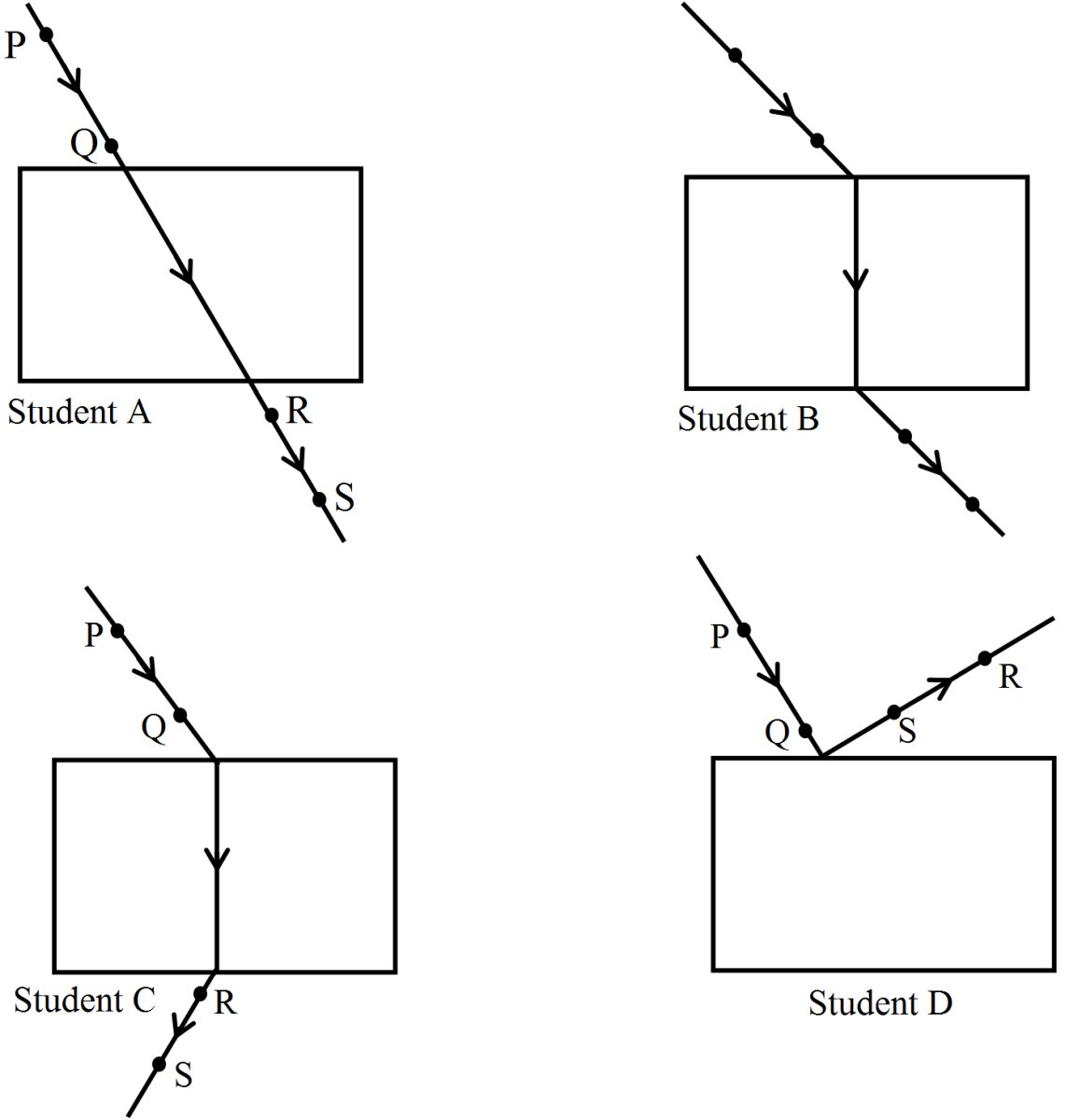
Four students A, B, C andDtracedthe paths of incident ray and the emergent ray by fixing pins P and Q for incident ray and pins R and S for emergent ray for ray of lightpassing through a glass slab.

The correct emergent ray was traced by the student:
A defective eye cannot see close objects clearly because their image is formed:
A student has obtained an image of a distant object on a screen to determine the focal length F1 of the given lens. His teacher after checking the image, gave him another lens of focal length F2 and asked to focus the same object on the same screen. The student found that to obtain a sharp image he has to move the lens away from the screen. From this finding we may conclude that both the lenses given to the student were:
Which of the following fuels has the highest calorific value?
  1. Natural gas.
  2. Methane gas.
  3. Hydrogen gas.
  4. Biogas.
The unit of current is:
The colour of scattered light depends on.