Question
The rectangular wire-frame, shown in figure, has a width d, mass m, resistance R and a large length. A uniform magnetic field B exists to the left of the frame. A constant force F starts pushing the frame into the magnetic field at t = 0.
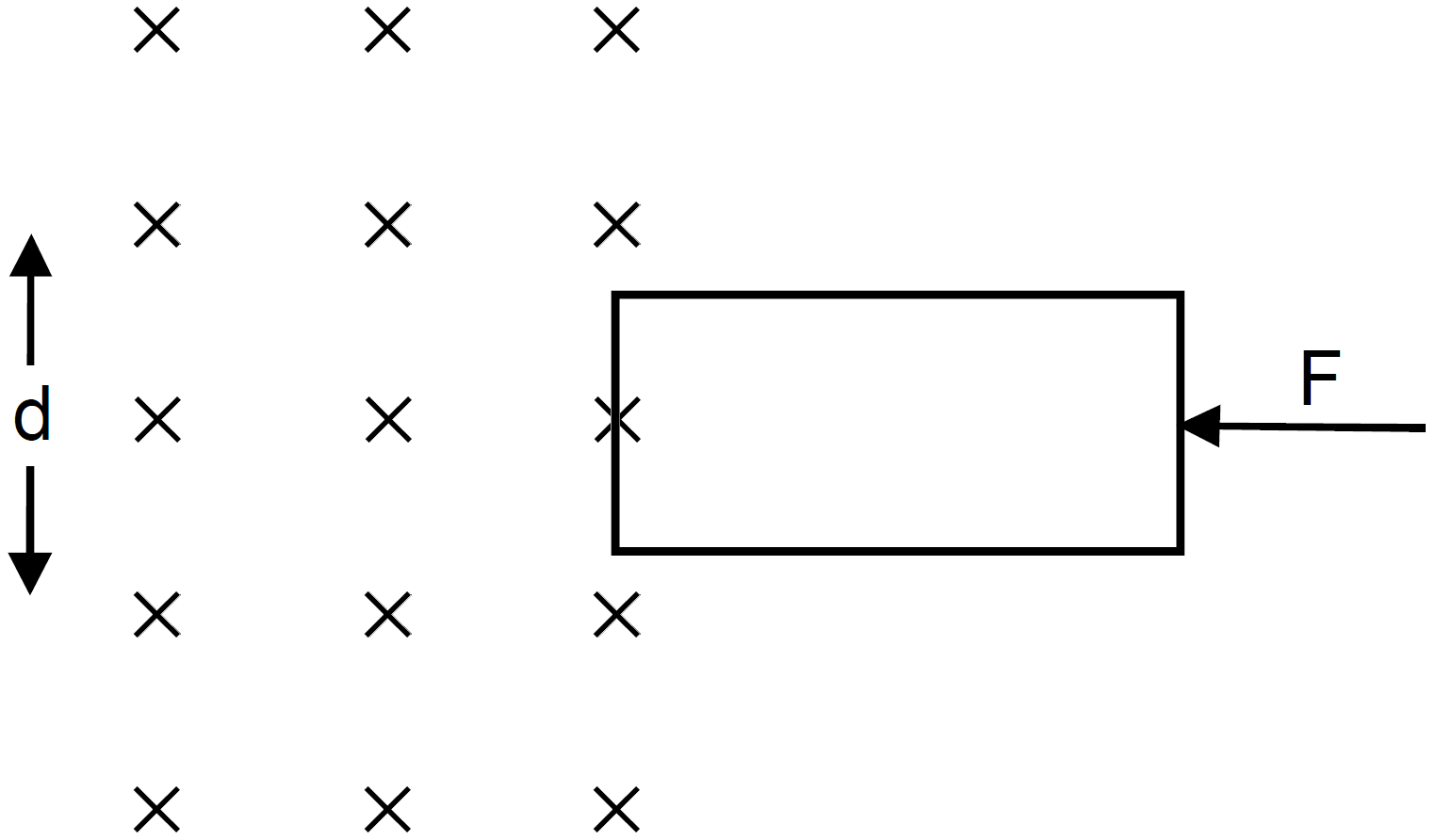
  1. Find the acceleration of the frame when its speed has increased to v.
  2. Show that after some time the frame will move with a constant velocity till the whole frame enters into the magnetic field. Find this velocity v0.
  3. Show that the velocity at time t is given by $\text{v}=\text{v}_0\Big(1-\text{e}^{-\frac{\text{ft}}{\text{mv}_0}}\Big)$
Answer

  1. emf developed = Bdv (when it attains a speed v)

Current $=\frac{\text{Bdv}}{\text{R}}$

Force $=\frac{\text{B}\text{d}^2\text{v}^2}{\text{R}}$

This force opposes the given force

Net F $=\text{F}-\frac{\text{B}\text{d}^2\text{v}^2}{\text{R}}=\text{RF}-\frac{\text{B}\text{d}^2\text{v}^2}{\text{R}}$

Net acceleration $=\frac{\text{RF}-\text{B}^2\text{d}^2\text{v}}{\text{mR}}$

  1. Velocity becomes constant when acceleration is 0.

$\frac{\text{F}}{\text{m}}-\frac{\text{B}^2\text{d}^2\text{v}_0}{\text{mR}}=0$

$\Rightarrow\frac{\text{F}}{\text{m}}=\frac{\text{B}^2\text{d}^2\text{v}_0}{\text{mR}}$

$\Rightarrow\text{v}_0=\frac{\text{FR}}{\text{B}^2\text{d}^2}$

  1. Velocity at line t

$\text{a}=-\frac{\text{dv}}{\text{dt}}$

$\Rightarrow\int_{0}^{\text{v}}\frac{\text{dv}}{\text{RF}-\text{l}^2\text{B}^2\text{v}}=\int_{0}^{\text{t}}\frac{\text{dt}}{\text{mR}}$

$\Rightarrow\Big[\text{l}_\text{n}\big[\text{RF}-\text{l}^2\text{B}^2\text{v}\big]\frac{1}{-\text{l}^2\text{B}^2}\Big]_0^{\text{v}} \ \Big[\frac{\text{t}}{\text{Rm}}\Big]_0^{\text{t}} $

$\Rightarrow\Big[\text{l}_\text{n}\big(\text{RF}-\text{l}^2\text{B}^2\text{v}\big)\Big]_{0}^{\text{v}}=\frac{-\text{tl}^2\text{B}^2}{\text{Rm}}$

$\Rightarrow\text{l}_\text{n}\big(\text{RF}-\text{l}^2\text{B}^2\text{v}\big)-\text{ln}(\text{RF})=\frac{-\text{t}^2\text{B}^2\text{t}}{\text{Rm}}$

$\Rightarrow1-\frac{\text{l}^2\text{B}^2\text{v}}{\text{Rf}}=\text{e}^{\frac {-\text{l}^2\text{B}^2\text{t}}{\text{Rm}}}$

$\Rightarrow\frac{\text{l}^2\text{B}^2\text{v}}{\text{Rf}}=1-\text{e}^{\frac {-\text{l}^2\text{B}^2\text{t}}{\text{Rm}}}$

$\Rightarrow\text{v}=\frac{\text{FR}}{\text{l}^2\text{B}^2}\Big(1-\text{e}^{\frac{-\text{l}^2\text{B}^2\text{v}_0\text{t}}{\text{Rv}_0\text{m}}}\Big)=\text{v}_0(1-\text{e}^{-\text{Fv}_0\text{m}})$

Need a full question paper?

Generate a complete, print-ready paper with questions like this in minutes — across 16+ boards, with answer keys.

Start Generating Free

Similar questions

Two tiny spheres carrying charges 1.5 µC and 2.5 µC are located 30 cm apart. Find the potential and electric field:
  1. At the mid-point of the line joining the two charges, and
  2. At a point 10 cm from this midpoint in a plane normal to the line and passing through the mid-point.
A radio can tune in to any station in the 7.5 MHz to 12 MHz band. What is the corresponding wavelength band?
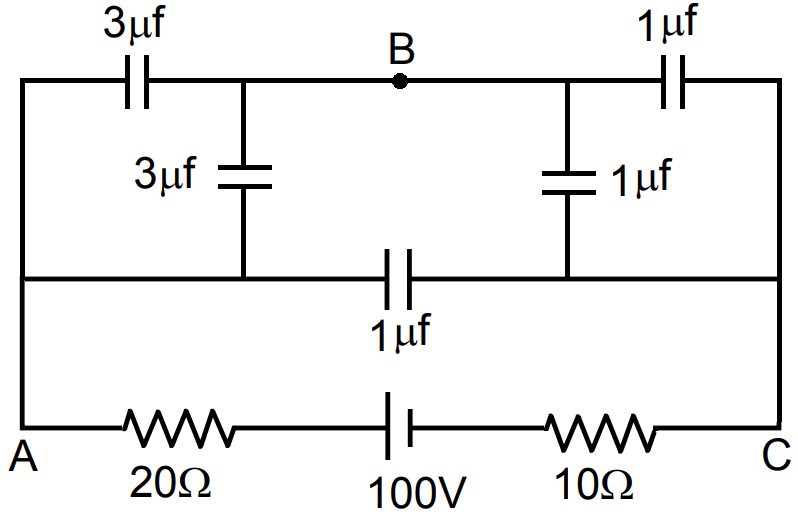
Find the potential difference between the points A and B and between the points B and C of the figure. in steady state.

Consider a given sample of an ideal gas $\Big(\frac{\text{C}_\text{P}}{\text{C}_\text{V}}=\gamma\Big)$ having initial pressure P0 and volume V0.
  1. The gas is isothermally taken to a pressure $\frac{\text{P}_0}{2}$ and from there, adiabatically to a pressure $\frac{\text{P}_0}{4}.$ Find the final volume.
  2. The gas is brought back to its initial state. It is adiabatically taken to a pressure $\frac{\text{P}_0}{2}$ and from there, isothermally to a pressure $\frac{\text{P}_0}{4}.$ Find the final volume.
Derive an expression for magnetic field intensity due to a magnetic dipole at a point lies on its equatorial line.
Suppose there is a circuit consisting of only resistances and batteries. Suppose one is to double (or increase it to n-times) all voltages and all resistances. Show that currents are unaltered.
A beam of monochromatic light of wavelength $\lambda$ ejects photoelectrons from a cesium surface $\big(\Phi=1.9\text{eV}\big).$ These photoelectrons are made to collide with hydrogen atoms in ground state. Find the maximum value of $\lambda$ for which (a) hydrogen atoms may be ionized, (b) hydrogen atoms may get excited from the ground state to the first excited state and (c) the excited hydrogen atoms may emit visible light.
A radioactive isotope has a half-life of T years. How long will it take the activity to reduce to
  1. 3.125%,
  2. 1% of its original value?
Ultraviolet light of wavelength 2271 Å from a 100 W mercury source irradiates a photo-cell made of molybdenum metal. If the stopping potential is –1.3 V, estimate the work function of the metal. How would the photo-cell respond to a high intensity (∼105 W m-2) red light of wavelength 6328 Å produced by a He-Ne laser?
An atom is in its excited state. Does the probability of its coming to ground state depend on whether the radiation is already present or not? If yes, does it also depend on the wavelength of the radiation present?