MCQ
The relation between faraday constant $F$, electron charge $e$ and avogadro number $N$ is
  • A
    $F=N / e$
  • $F=N e$
  • C
    $N=F^2$
  • D
    $F=N^2 e$

Answer

Correct option: B.
$F=N e$
(b) Faraday constant $=1$ mole electron charge $=\mathrm{Ne}$$=6.02 \times 10^{23} \times 1.6 \times 10^{-19}=96500$

Need a full question paper?

Generate a complete, print-ready paper with questions like this in minutes — across 16+ boards, with answer keys.
Start Generating Free

Similar questions

A rocket is ejecting $50$ of gases per sec at a speed of $500$. The accelerating force on the rocket will be
If $x$ longitudinal strain is produced in a wire of Young's modulus $y$, then energy stored in the material of the wire per unit volume is
A potentiometer wire has length $10 \mathrm{~m}$ and resistance $20 \Omega$. A 2. 5 $V$ battery of negligible internal resistance is connected across the wire with an $80 \Omega$ series resistance. The potential gradient on the wire will be
Where can a geostationary satellite be installed
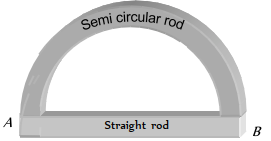
Two rods (one semi-circular and other straight) of same material and of same cross-sectional area are joined as shown in the figure. The points $A$ and $B$ are maintained at different temperature. The ratio of the heat transferred through a cross-section of a semicircular rod to the heat transferred through a cross section of the straight rod in a given time is
Image
The absolute temperatures of two black bodies are $2000 K$ and $3000 K$ respectively. The ratio of wavelengths corresponding to maximum emission of radiation by them will be
The refractive indices for the light of violet and red colours of any material are $1.66$ and $1.64$ respectively. If the angle of prism made of this material is $10,$ then angular dispersion will be
According to corpuscular theory of light, the different colours of light are due to
In an ammeter $0.2\%$ of main current passes through the galvanometer. If resistance of galvanometer is $G,$ the resistance of ammeter will be
At the top of the trajectory of a projectile, the directions of its velocity and acceleration are