The relationship between Young's modulus $Y,$ Bulk modulus $K$ and modulus of rigidity $\eta $ is
Diffcult


Download our appand get started for free
Experience the future of education. Simply download our apps or reach out to us for more information. Let's shape the future of learning together!No signup needed.*
Similar Questions
- 1A wire can be broken by applying a load of $20\,\,kg$ weight. The force required to break the wire of twice the diameter is ......... $kg\,wt$View Solution
- 2The ratio of diameters of two wires of same material is $n : 1$. The length of wires are $4\, m$ each. On applying the same load, the increase in length of thin wire will beView Solution
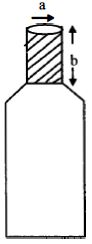
- 3A bottle has an opening of radius $a$ and length $b$. A cork of length band radius $\left( {a + \Delta a} \right)$ where $\left( {\Delta a < < a} \right)$ is compressed to fit into the opening completely (see figure). If the bulk modulus of cork is $B$ and frictional coefficient between the bottle and cork is $\mu $ then the force needed to push the cork into the bottle isView Solution
- 4The upper end of a wire $1\,m$ long and $4\,mm$ radius is clamped. The lower end is twisted by an angle of $30^o$. The angle of shear is ...... $^o$View Solution
- 5Given below are two statements: one is labelled as Assertion $A$ and the other is labelled as Reason $R$View Solution
Assertion $A$: Steel is used in the construction of buildings and bridges.
Reason $R:$ Steel is more elastic and its elastic limit is high.
In the light of above statements, choose the most appropriate answer from the options given below
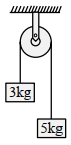
- 6Two blocks of masses $3 \,{kg}$ and $5\, {kg}$ are connected by a metal wire going over a smooth pulley. The breaking stress of the metal is $\frac{24}{\pi} \times 10^{2}\, {Nm}^{-2}$. What is the minimum radius of the wire? (Take $\left.g=10\, {ms}^{-2}\right)$ (in $cm$)View Solution
- 7An elastic material of Young's modulus $Y$ is subjected to a stress $S$. The elastic energy stored per unit volume of the material isView Solution
- 8Two wires are made of the same material and have the same volume. The first wire has cross-sectional area $A$ and the second wire has cross-sectional area $3A$. If the length of the first wire is increased by $\Delta l$ on applying a force $F$, how much force is needed to stretch the second wire by the same amount?View Solution
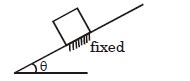
- 9View SolutionAssume that a block of very low shear modulus is fixed on an inclined plane as shown. Due to elastic forces it will deform. What will be the shape of the block ?
- 10A wire is stretched by $0.01$ $m$ by a certain force $F.$ Another wire of same material whose diameter and length are double to the original wire is stretched by the same force. Then its elongation will beView Solution