A wire can be broken by applying a load of $20\,\,kg$ weight. The force required to break the wire of twice the diameter is ......... $kg\,wt$
Medium


Download our appand get started for free
Experience the future of education. Simply download our apps or reach out to us for more information. Let's shape the future of learning together!No signup needed.*
Similar Questions
- 1View SolutionLiquids have no Poisson's ratio, because
- 2View SolutionIf the length of a wire is made double and radius is halved of its respective values. Then, the Young's modules of the material of the wire will :
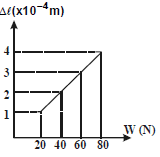
- 3The adjacent graph shows the extension $(\Delta l)$ of a wire of length $1\, m$ suspended from the top of a roof at one end and with a load $W$ connected to the other end. If the cross-sectional area of the wire is $10^{-6}\, m^2$, calculate the Young’s modulus of the material of the wire.View Solution
- 4View SolutionIf the temperature increases, the modulus of elasticity
- 5An aluminum rod (Young's modulus $ = 7 \times {10^9}\,N/{m^2})$ has a breaking strain of $0.2\%$. The minimum cross-sectional area of the rod in order to support a load of ${10^4}$Newton's isView Solution
- 6The work done in increasing the length of a $1$ $metre$ long wire of cross-section area $1\, mm^2$ through $1\, mm$ will be ....... $J$ $(Y = 2\times10^{11}\, Nm^{-2})$View Solution
- 7The bulk moduli of ethanol, mercury and water are given as $0.9, 25$ and $2 .2$ respectively in units of $10^9\, Nm^{-2}$ . For a given value of pressure, the fractional compression in volume is $\frac{{\Delta V}}{V}$. Which of the following statements about $\frac{{\Delta V}}{V}$ for these three liquids is correct ?View Solution
- 8Given : $\sigma$ is the compressibility of water, $\rho$ is the density of water and $K$ is the bulk modulus of water. What is the energy density of water at the bottom of a lake $‘h’$ metre deep ?View Solution
- 9Two wires of same length and radius are joined end to end and loaded. The Young's modulii of the materials of the two wires are $Y_{1}$ and $Y_{2}$. The combination behaves as a single wire then its Young's modulus is:View Solution
- 10Two similar wires under the same load yield elongation of $0.1$ $mm$ and $0.05$ $mm$ respectively. If the area of cross- section of the first wire is $4m{m^2},$ then the area of cross section of the second wire is..... $mm^2$View Solution