Question
The relaxation time in conductors:

Answer

  1. Decreases with the increases of temperature.

Need a full question paper?

Generate a complete, print-ready paper with questions like this in minutes — across 16+ boards, with answer keys.
Start Generating Free

Similar questions

Magnetic moment of a thin bar magnet is M. If it is cut first perpendicular to length and then perpendicular to breadth, then magnetic moment of obtained piece is:
In Young’s experiment, the distance between slits is 0.28 mm and distance between slits and screen is 1.4 m. Distance between central bright fringe and third bright fringe is 0.9 cm. What is the wavelength of used light (a) 5000 Å(b) 6000 Å(c) 7000 Å(d) 9000 Å
       
For nuclei with A > 100:
  1. The binding energy of the nucleus decreases on an average as A increases.
  2. The binding energy per nucleon decreases on an average as A increases.
  3. If the nucleus breaks into two roughly equal parts, energy is released.
  4. If two nuclei fuse to form a bigger nucleus, energy is released.
A capacitor becomes a perfect insulator for:
A glass lens is placed in a medium in which it is found to behave like a glass plate. Refractive index of the medium will be(a) Greater than the refractive index of glass(b) Smaller than the refractive index of glass(c) Equal to refractive index of glass(d) No case will be possible from above 


Assertion : The force of repulsion between atomic nucleus and $\alpha-$particle varies with distance according to inverse square law. 
Reason : Rutherford did a-particle scattering experiment.
Resistance of a circuit is $12 \Omega$ and impedance is $15 \Omega$. The power factor of the circuit is :
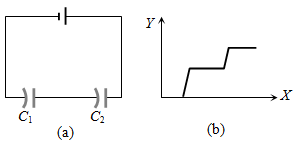
Figure $(a)$ shows two capacitors connected in series and joined to a battery. The graph in figure $(b)$ shows the variation in potential as one moves from left to right on the branch containing the capacitors, if
In Boolean algebra A.B=Y implies the:
A narrow beam of white light goes through a slab having parallel faces.
  1. The light never splits in different colours.
  2. The emergent beam is white.
  3. The light inside the slab is split into different colours.
  4. The light inside the slab is white.