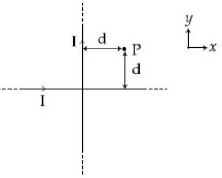
Two very long, straight and insulated wires are kept at $90^o$ angle from each other In $xy -$ plane as shown in the figure. These wires carry current of equal magnitude $I$, whose directions are shown in the figure. The net magnetic field at point $P$ will be
JEE MAIN 2019, Medium


Download our appand get started for free
Experience the future of education. Simply download our apps or reach out to us for more information. Let's shape the future of learning together!No signup needed.*
Similar Questions
- 1${H^ + },\,H{e^ + }$ and ${O^{ + + }}$ ions having same kinetic energy pass through a region of space filled with uniform magnetic field $B$ directed perpendicular to the velocity of ions. The masses of the ions ${H^ + },\,H{e^ + }$and ${O^{ + + }}$ are respectively in the ratio $1:4:16$. As a resultView Solution
- 2View SolutionA charged particle moves through a magnetic field perpendicular to its direction. Then
- 3If a proton is projected in a direction perpendicular to a uniform magnetic field with velocity $v$ and an electron is projected along the lines of force, what will happen to proton and electronView Solution
- 4A moving coil galvanometer has $150$ equal divisions. Its current sensitivity is $10$ divisions per milliampere and voltage sensitivity is $2$ divisions per millivolt. In order that each division reads $1\, volt$, the resistance in $ohms$ needed to be connected in series with the coil will beView Solution
- 5View SolutionBy ammeter, which of the following can be measured
- 6Two concentric coplanar circular loops of radii ${r_1}$ and ${r_2}$ carry currents of respectively ${i_1}$ and ${i_2}$ in opposite directions (one clockwise and the other anticlockwise.) The magnetic induction at the centre of the loops is half that due to ${i_1}$ alone at the centre. If ${r_2} = 2{r_1}.$ the value of ${I_2}/{I_1}$ is....View Solution
- 7In an ionised sodium atom, an electron is moving in a circular path of radius $r$ with angular velocity $\omega $. The magnetic induction in $wb/m^2$ produced at the nucleus will beView Solution
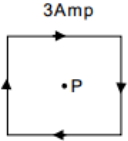
- 8Find magnetic field at centre $P$ if length of side of square loop is $20\, cm$View Solution
- 9View SolutionMotion of a moving electron is not affected by
- 10A current carrying long solenoid is placed on the ground with its axis vertical. A proton is falling along the axis of the solenoid with a velocity $v$. When the proton enters into the solenoid, it willView Solution