The resistance of a rectangular block of copper of dimensions $2 \,mm \times 2 \,mm \times 5 \,m$ between two square faces is $0.02 \,\Omega$. What is the resistivity of copper?
Easy


Download our appand get started for free
Experience the future of education. Simply download our apps or reach out to us for more information. Let's shape the future of learning together!No signup needed.*
Similar Questions
- 1A thermocouple of negligible resistance produces an $e.m.f.$ of $40\,\mu V{/^o}C$ in the linear range of temperature. A galvanometer of resistance $10\; ohm$ whose sensitivity is $1\;\mu A/div$, is employed with the thermocouple. The smallest value of temperature difference that can be detected by the system will beView Solution
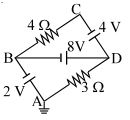
- 2The figure shows a network of resistances in which the point $A$ is earthed. The point which has the least potential isView Solution
- 3Two identical cells, when connected either in parallel or in series gives same current in an external resistance $5\,\Omega$. The internal resistance of each cell will be $.............\,\Omega$.View Solution
- 4A $100\, V$ voltmeter of internal resistance $20\,k\Omega $ in series with a high resistance $R$ is connected to a $110\, V$ line. The voltmeter reads $5\, V$, the value of $R$ is ................ $k \Omega $View Solution
- 5View SolutionA piece of wire is cut into four equal parts and the pieces are bundled together side by side to form a thicker wire. Compared with that of the original wire, the resistance of the bundle is ..........
- 6A steady current $I$ flows through a wire of radius $r$, length $L$ and resistivity $\rho$. The current produces heat in the wire. The rate of heat loss in a wire is proportional to its surface area. The steady temperature of the wire is independent ofView Solution
- 7Carbon resistor has resistance specified by three bands having colour red, yellow and black. If this resistor is cut into two pieces of equal length then the new colour code of each one will be (Neglect tolerance of $4^{th}$ band)View Solution
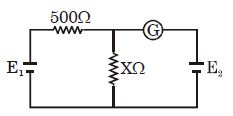
- 8In the adjoining circuit, the battery $E_1$ has an $e.m.f.$ of $12\, volts$ and zero internal resistance, while the battery $E_2$ has an $e.m.f.$ of $2\, volts$. If the galvanometer $G$ reads zero, then the value of the resistance $X$ in $ohms$ isView Solution
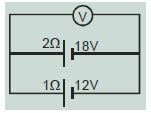
- 9Two batteries, one of $emf$ $18\, volts$ and internal resistance $2\,\Omega $ and the other of $emf$ $12\, volt$ and internal resistance $1\,\Omega $, are connected as shown. The voltmeter $V$ will record a reading of .............. $\mathrm{volt}$View Solution
- 10View SolutionIn the experiment of potentiometer, at balance, there is no current in the