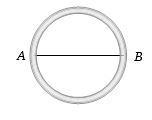
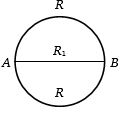
The resistance of a wire is ${10^{ - 6}}\,\Omega $ per meter. It is bend in the form of a circle of diameter $2\,m$. A wire of the same material is connected across its diameter. The total resistance across its diameter $AB$ will be
Medium


Download our appand get started for free
Experience the future of education. Simply download our apps or reach out to us for more information. Let's shape the future of learning together!No signup needed.*
Similar Questions
- 1View SolutionCurrent provided by a battery is maximum when
- 2Four resistances $10$ $\Omega$, $5$ $\Omega$, $7$ $\Omega$ and $3$ $\Omega$ are connected so that they form the sides of a rectangle $AB$, $BC$, $CD$ and $DA$ respectively. Another resistance of $10$ $\Omega$ is connected across the diagonal $AC$. The equivalent resistance between $A$ and $B $ is .............. $\Omega$View Solution
- 3Two wires each of radius of cross section $r$ but of different materials are connected together end to end (in series). If the densities of charge carriers in the two wires are in the ratio $1 : 4$, the drift velocity of electrons in the two wires will be in the ratio:View Solution
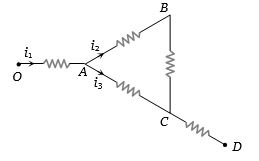
- 4The current in the arm $CD$ of the circuit will beView Solution
- 5A potentiometer wire of length $10 \,m$ and resistance$20 \,\Omega$ is connected in series with a $25 \,V$ battery and an external resistance $30\, \Omega$. A cell of emf $E$ in secondary circuit is balanced by $250\, cm$ long potentiometer wire. The value of $E$ (in volt) is $\frac{x}{10}$. The value of $x$ is.......View Solution
- 6View SolutionThe resistivity of a wire depends on its
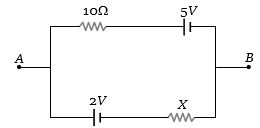
- 7If ${V_{AB}} = 4\,V$ in the given figure, then resistance $X$ will be .............. $\Omega$View Solution
- 8Two batteries with e.m.f $12\ V$ and $13\ V$ are connected in parallel across a load resistor of $10\,\Omega$ . The internal resistances of the two batteries are $1\,\Omega$ and $2\,\Omega$ respectively. The voltage across the load lies betweenView Solution
- 9If $n,\,e,\,\tau $ and $m$ respectively represent the density, charge relaxation time and mass of the electron, then the resistance of a wire of length $l$ and area of cross-section $A$ will beView Solution
- 10View SolutionThe maximum current that flows through a fuse wire before it blows out varies with its radius as