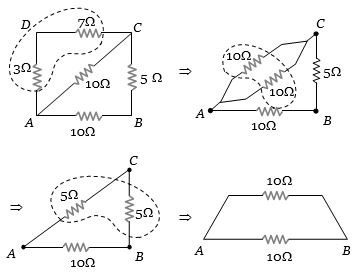
Four resistances $10$ $\Omega$, $5$ $\Omega$, $7$ $\Omega$ and $3$ $\Omega$ are connected so that they form the sides of a rectangle $AB$, $BC$, $CD$ and $DA$ respectively. Another resistance of $10$ $\Omega$ is connected across the diagonal $AC$. The equivalent resistance between $A$ and $B $ is .............. $\Omega$
Medium


Download our appand get started for free
Experience the future of education. Simply download our apps or reach out to us for more information. Let's shape the future of learning together!No signup needed.*
Similar Questions
- 1How much energy in kilowatt hour is consumed in operating ten $50\, watt$ bulbs for $10$ hours per day in a month ($30$ days).View Solution
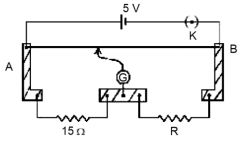
- 2A meter bridge setup is shown in the figure. It is used to determine an unknown resistance $R$ using a given resistor of $15\,\Omega$. The galvanometer $(G)$ shows null deflection when tapping key is at $43\,cm$ mark from end $A$. If the end correction for end $A$ is $2\,cm$. then the determined value of $R$ will be__________ $\Omega$View Solution
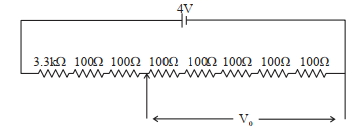
- 3A potential divider circuit is shown in figure. The output voltage $V_0$ isView Solution
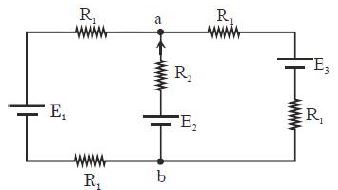
- 4For the circuit shown, with ${R_1} = 1.0\,\Omega $, ${R_2} = 2.0\,\Omega $, ${E_1} = 2\,V$ and ${E_2} = {E_3} = 4\,V$, the potential difference between the points $‘a’$ and $‘b’$ is approximately (in $V$)View Solution
- 5The resistance of the filament of an electric bulb changes with temperature. If an electric bulb rated $220\, volt$ and $100\, watt$ is connected $(220 \times 0.8)$ $volt$ sources, then the actual power would beView Solution
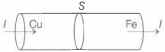
- 6Two rods of copper and iron with the same cross-sectional area are joined at $S$ and a steady current $I$ flows through the rods as shown in the figure. Choose the most appropriate representation of charges accumulated near the junction $S$.View Solution
- 7At what temperature will the resistance of a copper wire become three times its value at $0\,^oC$ ................. $^oC$ (Temperature coefficient of resistance for copper = $4 × 10^{-3} \,per\, \,^oC$ )View Solution
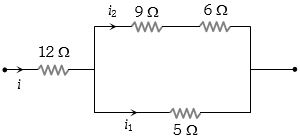
- 8In the following circuit, $5$ $\Omega$ resistor develops $45$ $J/s$ due to current flowing through it. The power developed per second across $12$ $\Omega$ resistor is ............. $W$View Solution
- 9The resistance per centimeter of a meter bridge wire is $\mathrm{r}$, with $\mathrm{X}\ \Omega$ resistance in left gap. Balancing length from left end is at $40 \mathrm{~cm}$ with $25\ \Omega$ resistance in right gap. Now the wire is replaced by another wire of $2 \mathrm{r}$ resistance per centimeter. The new balancing length for same settings will be atView Solution
- 10In the diagram resistance between any two junctions is $R$. Equivalent resistance across terminals $A$ and $B$ isView Solution
