The resistance of a wire is $R$. It is bent at the middle by $180^{\circ}$ and both the ends are twisted together to make a shorter wire. The resistance of the new wire is
Easy


Download our appand get started for free
Experience the future of education. Simply download our apps or reach out to us for more information. Let's shape the future of learning together!No signup needed.*
Similar Questions
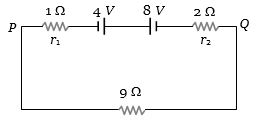
- 1Two batteries of $e.m.f.$ $4\,V$ and $8 \,V$ with internal resistances $1\, \Omega$ and $2\,\Omega$ are connected in a circuit with a resistance of $9 \,\Omega$ as shown in figure. The current and potential difference between the points $P$ and $Q$ areView Solution
- 2Three bulbs of $40\,W$, $60\,W$ and $100\,W$ are arranged in series with $220\,V$. Which bulb has minimum resistance............... $W$View Solution
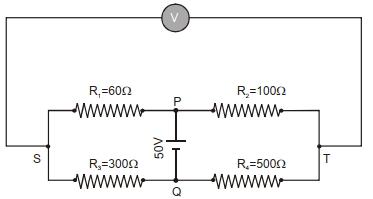
- 3In the balanced condition, the values of the resistances of the four arms of a Wheatstone bridge are shown in the figure below. The resistance $R_3$ has temperature coefficient $0.0004{ }^{\circ} C ^{-1}$. If the temperature of $R_3$ is increased by $100{ }^{\circ} C$, the voltage developed between $S$ and $T$ will be. . . . . . . volt.View Solution
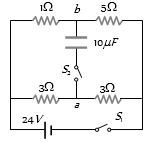
- 4In the circuit shown in figure, switch $S_1$ is initially closed and $S_2$ is open. Find $V_a -V_b$ .............. $V$View Solution
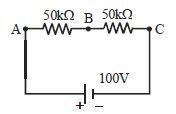
- 5In the adjacent shown circuit, a voltmeter of internal resistance $R$, when connected across $B$ and $C$ reads $\frac{{100}}{3}\,V$. Neglecting the internal resistance of the battery, the value of $R$ is ................. $k \Omega$View Solution
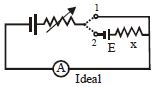
- 6In the circuit shown the variable resistance is so adjusted that the ammeter reading is same in both the position $1$ and $2$ of the key. The reading of ammeter is $2A$. If $E = 20V$, then $x$ is :- ................... $\Omega$View Solution
- 7An electric kettle has two coils. When one of these is switched on, the water in the kettle boils in $6\,\min$ . When the other coil is switched on, the water boils in $3\,\min$. If the two coils are connected in series, the time taken to boil the water in the kettle is ............. $min$View Solution
- 8When a current $I$ is passed through a wire of constant resistance, it produces a potential difference $V$ across its ends. The graph drawn between $\log\, I$ and $\log\, V$ will beView Solution
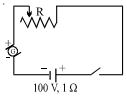
- 9The battery in the diagram is to be charged by the generator $G$. The generator has a terminal voltage of $120$ $\mathrm{volts}$ when the charging current is $10$ $\mathrm{amperes}.$ The battery has an $\mathrm{emf}$ of $100$ $\mathrm{volts}$ and an internal resistance of $1$ $\mathrm{ohm}.$ In order to charge the battery at $10$ $\mathrm{amperes}$ charging current, the resistance $R$ should be set at ................ $\Omega$View Solution
- 10A current of $1\, mA$ is flowing through a copper wire. How many electrons will pass a given point in one secondView Solution