The resistance of a wire is $R$. It is bent at the middle by $180^o$ and both the ends are twisted together to make a shorter wire. The resistance of the new wire is
AIEEE 2012, Medium
Download our app for free and get started
Resistance of wire $(R)=\rho \frac{1}{A}$
If wire is bent in the middle then
$l'=\frac{1}{2}, A^{\prime}=2\, A$
$\therefore $ $\text { New resistance, } \mathrm{R}^{\prime} =\rho \frac{l^{\prime}}{\mathrm{A}^{\prime}} $
$=\frac{\rho \frac{l}{2}}{2\, A}=\frac{\rho l}{4\, A}=\frac{R}{4}$

Download our appand get started for free
Experience the future of education. Simply download our apps or reach out to us for more information. Let's shape the future of learning together!No signup needed.*
Similar Questions
- 1View SolutionWatt-hour meter measures
- 2An electric kettle has two heating coils. When one of the coils is connected to an a.c. sotuce, the water in the kettle boils in $10$ minutes. When the other coil is used the w’ater boils in $40$ minutes. If both the coils are connected in parallel, the time taken by the same quantity of water to boil will be ...... $min$View Solution
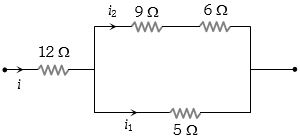
- 3In the following circuit, $5$ $\Omega$ resistor develops $45$ $J/s$ due to current flowing through it. The power developed per second across $12$ $\Omega$ resistor is ............. $W$View Solution
- 4View SolutionA wire of a certain material is stretched slowly by ten percent. Its new resistance and specific resistance become respectively
- 5For comparing the $e.m.f.$'s of two cells with a potentiometer, a standard cell is used to develop a potential gradient along the wires. Which of the following possibilities would make the experiment unsuccessfulView Solution
- 6Two resistances are connected in two gaps of a meter bridge. The balance point is $20\, cm$ from the zero end. A resistance of $15\, ohms$ is connected in series with the smaller of the two. The null point shifts to $40\, cm$. The value of the smaller resistance in $ohms$ isView Solution
- 7View SolutionIn meter bridge or Wheatstone bridge for measurement of resistance, the known and the unknown resistances are interchanged. The error so removed is
- 8A wire of resitance $R$ and length $L$ is cut into $5$ equal part. if these parts are joined parts are joined paralley, than result resistance will be:View Solution
- 9At what rate the potential difference between the plates of a capacitor be changed to set up a displacement current of $1\, A$ in a capacitor of $2\,\mu F$ ?View Solution
- 10One end of a Nichrome wire of length $2\,L$ and cross-sectional area $A$ is attatched to an end of another Nichrome wire of length $L$ and cross-sectional area $2\,A$. If the free end of the longer wire is at an electric potential of $8.0$ $\mathrm{volts}$, and the free end of the shorter wire is at an electric potential of $1.0$ $\mathrm{volt}$, the potential at the junction of the two wires is equal to ............. $V$View Solution