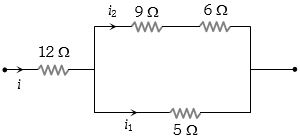
In the following circuit, $5$ $\Omega$ resistor develops $45$ $J/s$ due to current flowing through it. The power developed per second across $12$ $\Omega$ resistor is ............. $W$
Diffcult
Download our app for free and get started
(b) $\frac{{{i_1}}}{{{i_2}}} = \frac{{15}}{5} = \frac{3}{1}$… $(i)$
Also $\frac{H}{t} = {i^2}R \Rightarrow 45 = {({i_1})^2} \times 5$
$ \Rightarrow $ ${i_1} = 3\,A$ and from equation $(i)$ ${i_2} = 1\,A$
So $i = {i_1} + {i_2} = 4\,A$
Hence power developed in $12\,\Omega $ resistance $P = {i^2}R = {(4)^2} \times 12 = 192\,W$
Also $\frac{H}{t} = {i^2}R \Rightarrow 45 = {({i_1})^2} \times 5$
$ \Rightarrow $ ${i_1} = 3\,A$ and from equation $(i)$ ${i_2} = 1\,A$
So $i = {i_1} + {i_2} = 4\,A$
Hence power developed in $12\,\Omega $ resistance $P = {i^2}R = {(4)^2} \times 12 = 192\,W$

Download our appand get started for free
Experience the future of education. Simply download our apps or reach out to us for more information. Let's shape the future of learning together!No signup needed.*
Similar Questions
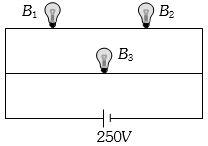
- 1A $100\, W$ bulb $B_1$, and two $60\,W$ bulbs $B_2$ and $B_3$, are connected to a $250\, V$ source, as shown in the figure. Now $ W_1, W_2$ and $W_3$ are the output powers of the bulbs $B_1, B_2$ and $B_3$, respectively. ThenView Solution
- 2The resistances of a wire at temperatures $t\,^oC$ and $0\,^oC$ are related byView Solution
- 3View SolutionIn a sensitive meter bridge apparatus the bridge wire should possess
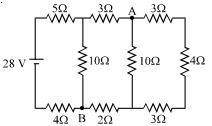
- 4View SolutionConsider the circuit shown in the figure
- 5Consider four conducting materials copper, tungsten, mercury and aluminium with resistivity $\rho_{ C }, \rho_{ T }, \rho_{ M }$ and $\rho_{ A }$ espectively Then:View Solution
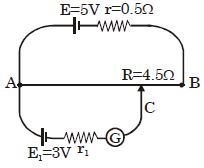
- 6In the given potentiometer circuit length of the wire $AB$ is $3\,m$ and resistance is $R = 4.5 \,\Omega.$ The length $AC$ for no deflection in galvanometer is ................ $\mathrm{m}$View Solution
- 7The heat generated through $2 \,ohm$ and $8\, ohm$ resistances separately, when a condenser of $200\,\mu F$ capacity charged to $200\, V$ is discharged one by one, will beView Solution
- 8A potentiometer wire is $100\,\, cm$ long and a constant potential difference is maintained across it. Two cells are connected in series first to support one another and then in opposite direction. The balance points are obtained at $50\,\, cm$ and $10\,\, cm$ from the positive end of the wire in the two cases. The ratio of emf's isView Solution
- 9The temperature coefficient of resistance for a wire is $0.00125\,^oC$. At $300\,K$ its resistance is $1\, ohm$. The temperature at which the resistance becomes $2\, ohm$ is .......... $K$View Solution
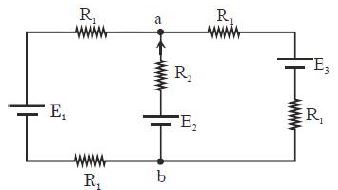
- 10For the circuit shown, with ${R_1} = 1.0\,\Omega $, ${R_2} = 2.0\,\Omega $, ${E_1} = 2\,V$ and ${E_2} = {E_3} = 4\,V$, the potential difference between the points $‘a’$ and $‘b’$ is approximately (in $V$)View Solution