For comparing the $e.m.f.$'s of two cells with a potentiometer, a standard cell is used to develop a potential gradient along the wires. Which of the following possibilities would make the experiment unsuccessful
Easy


Download our appand get started for free
Experience the future of education. Simply download our apps or reach out to us for more information. Let's shape the future of learning together!No signup needed.*
Similar Questions
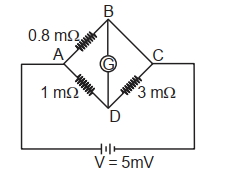
- 1To measure the temperature coefficient of resistivity $\alpha$ of a semiconductor, an electrical arrangement shown in the figure is prepared. The arm BC is made up of the semiconductor. The experiment is being conducted at $25^{\circ} \mathrm{C}$ and resistance of the semiconductor arm is $3 \mathrm{~m} \Omega$. Arm BC is cooled at a constant rate of $2^{\circ} \mathrm{C} / \mathrm{s}$. If the galvanometer $\mathrm{G}$ shows no deflection after $10 \mathrm{~s}$, then $\alpha$ is :View Solution
- 2Two cells of same emf but different internal resistances $I_{1}$ and $I_{2}$ are connected in series with a resistance $R$. The value of resistance $R$, for which the potential difference across second cell is zero, isView Solution
- 3A copper wire of length $1\, m$ and radius $1\, mm$ is joined in series with an iron wire of length $2\, m$ and radius $3\, mm$ and a current is passed through the wires. The ratio of the current density in the copper and iron wires isView Solution
- 4The internal resistance of a primary cell is $4\, ohm$. It generates a current of $0.2\, amp$ in an external resistance of $21\, ohm$. The rate at which chemical energy is consumed in providing the current is .............. $J/s$View Solution
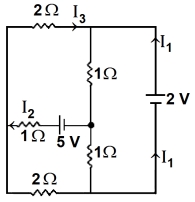
- 5Consider the circuit shown in the figure. The current $I_3$ is equal toView Solution
- 6For a wire $\frac{R}{l}=\frac{1}{2}$ and length of wire is $l=5\, cm .$ If potential difference $1\, V$ is applied across it, current through wire will be: $( R =$ Resistance $)$ (in $A$)View Solution
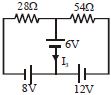
- 7In the following circuit, the magnitude of current $I _{ l }$, is $............A$.View Solution
- 8An electrical circuit consists of ten $100 \,\Omega$ resistors. Out of these $10$ resistors, a group of $n _1$ resistors are connected in parallel and another group of $n _2$ resistors are separately connected in parallel. These two groups are then connected in series and this combination is connected to a voltage source of $100 \,V$. If the net current though the circuit is $2.5 \,A$. The values of $n _1$ and $n _2$ areView Solution
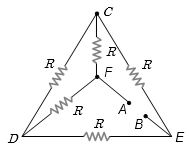
- 9Five equal resistances each of resistance $R$ are connected as shown in the figure. A battery of $V\, volts$ is connected between $A$ and $B$. The current flowing in $AFCEB$ will beView Solution
- 10How many $60 \,W$ bulbs may be safely run on $220 \,V$ using a $5 \,A$ fuse is .........View Solution