The resistance of an ammeter is $13\, \Omega$ and its scale is graduated for a current upto $100$ $amps$. After an additional shunt has been connected to this ammeter it becomes possible to measure currents upto $750$ $ampere$ by this meter. The value of shunt-resistance is
AIPMT 2007, Medium
Download our app for free and get started
Let the shunt resistance be $S$.
Given: $I=750\, \mathrm{A}$
$I_{\mathrm{g}}=100\, \mathrm{A}, R_{G}=13\, \Omega$
From the figure,
$I_{g} R_{G}=\left(I-I_{g}\right) S$
or $100 \times 13=[750-100] S$
or $1300=650\, S$
$\therefore S=1300 / 650=2\, \Omega$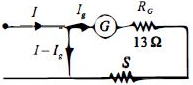

Download our appand get started for free
Experience the future of education. Simply download our apps or reach out to us for more information. Let's shape the future of learning together!No signup needed.*
Similar Questions
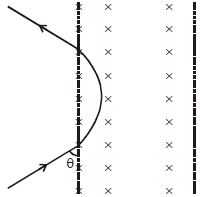
- 1View SolutionA positively charged particle enters in a region of uniform. Transverse magnetic field as shown in figure find net deviation in path of the particle.
- 2An electron of charge $e$ moves in a circular orbitof radius $r$ around the nucleus at a frequency $v$. The magnetic moment associated with the orbital motion of the electron isView Solution
- 3A long solenoid of radius $2\, cm$ has $100\, turns/cm$ and carries a current of $5\,A$. A coil of radius $1\, cm$ having $100\, turns$ and a total resistance of $20\,\Omega $ is placed inside the solenoid coaxially. The coil is connected to a galvanometer. If the current in the solenoid is reversed in direction, find the charge flown through the galvanometerView Solution
- 4View SolutionThe time period of a charged particle undergoing a circular motion in a uniform magnetic field is independent of its
- 5View SolutionA loop of flexible wire of irregular shape carrying current is placed in an external magnetic field. Identify the effect of the field on the wire.
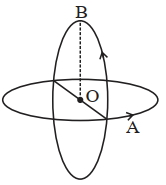
- 6Two insulated circular loop $A$ and $B$ radius ' $a$ ' carrying a current of ' $\mathrm{I}$ ' in the anti clockwise direction as shown in figure. The magnitude of the magnetic induction at the centre will be :View Solution
- 7A horizontal rod of mass $10\, gm$ and length $10\, cm$ is placed on a smooth plane inclined at an angle of $60^\circ $ with the horizontal, with the length of the rod parallel to the edge of the inclined plane. A uniform magnetic field of induction $B$ is applied vertically downwards. If the current through the rod is $1.73$ $ampere$, then the value of $B$ for which the rod remains stationary on the inclined plane is......$Tesla$View Solution
- 8View SolutionThe time period of a charged particle undergoing a circular motion in a uniform magnetic field is independent of its
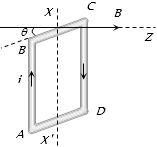
- 9In the previous question, if the current is $i$ and the magnetic field at $D$ has magnitude $B$,View Solution
- 10The square loop $ABCD$, carrying a current $i$, is placed in uniform magnetic field $B$, as shown. The loop can rotate about the axis $XX$'. The plane of the loop makes and angle $\theta$ ($\theta$ $< 90^o$) with the direction of $B$. Through what angle will the loop rotate by itself before the torque on it becomes zeroView Solution