MCQ
The resultant amplitude due to superposition of two waves $y_1 = 5\,\,sin (wt - kx)$ and $y_2 = -5 \,\,cos (wt - kx - 150^o)$
  • $5$
  • B
    $5\sqrt 3 $
  • C
    $5\sqrt {2 - \sqrt 3 }$
  • D
    $5\sqrt {2 + \sqrt 3 }$

Answer

Correct option: A.
$5$
a
$y_{1}=5 \sin (\omega t-k x)$

$y_{2}=-5 \cos \left(\omega t-k x-150^{\circ}\right)$

$y_{1}+y_{2}=5\left(\sin (\omega t-k x)-\sin \left(\omega t-k x-60^{\circ}\right)\right)$

$=10\left(\sin 30^{\circ} \cos \left(\omega t-k x-30^{\circ}\right)\right)$

$=5 \cos \left(\omega t-k x-30^{\circ}\right)$

Need a full question paper?

Generate a complete, print-ready paper with questions like this in minutes — across 16+ boards, with answer keys.
Start Generating Free

Similar questions

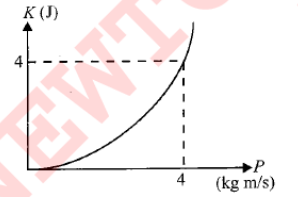
The graph between kinetic energy and momentum of a particle is plotted as shown in Fig. The mass of the moving particle is?
In an clockwise system
Two wires $A$ and $B$ are of same materials. Their lengths are in the ratio $1 : 2$ and diameters are in the ratio $2 : 1$ when stretched by force ${F_A}$ and ${F_B}$ respectively they get equal increase in their lengths. Then the ratio ${F_A}/{F_B}$ should be
$A$ block of mass $m$ moving with a velocity $v_0$ on a smooth horizontal surface strikes and compresses a spring of stiffness $k$ till mass comes to rest as shown in the figure. This phenomenon is observed by two observers:

$A$: standing on the horizontal surface

$B$: standing on the block 

To an observer $A$, the work done by spring force is 

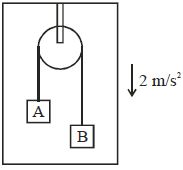
Block $A$ and $B$ of mass $2\,kg$ and $4\,kg$ are suspended through a string using a pulley, inside an elevator moving downward with constant acceleration $2\,m/s^2$. The tension in the string which is joining two blocks
A stone is projected from the ground with velocity $25\,m/s$. Two seconds later, it just clears a wall $5 \,m$ high. The angle of projection of the stone is ........ $^o$ $(g = 10m/{\sec ^2})$
If a glass rod is dipped in mercury and withdrawn out, the mercury does not wet the rod because
The displacement $y$ (in $cm$) produced by a simple harmonic wave is $y = \frac{{10}}{\pi }\sin \left( {2000\pi t - \frac{{\pi x}}{{17}}} \right)$. The periodic time and maximum velocity of the particles in the medium will respectively be
A constant torque of $31.4\, Nm$ is exerted on a pivoted wheel. If the angular acceleration of the wheel is $4 \pi\, rad/sec^2$, then the moment of inertia will be ....... $kg-m^2$
A particle is acted simultaneously by mutually perpendicular simple hormonic motions $\text{x}=\text{a}\cos\omega\text{t}\ \text{and}\ \text{y}=\text{a}\sin\omega\text{t}.$ The trajectory of motion of the particle will be: