Answer

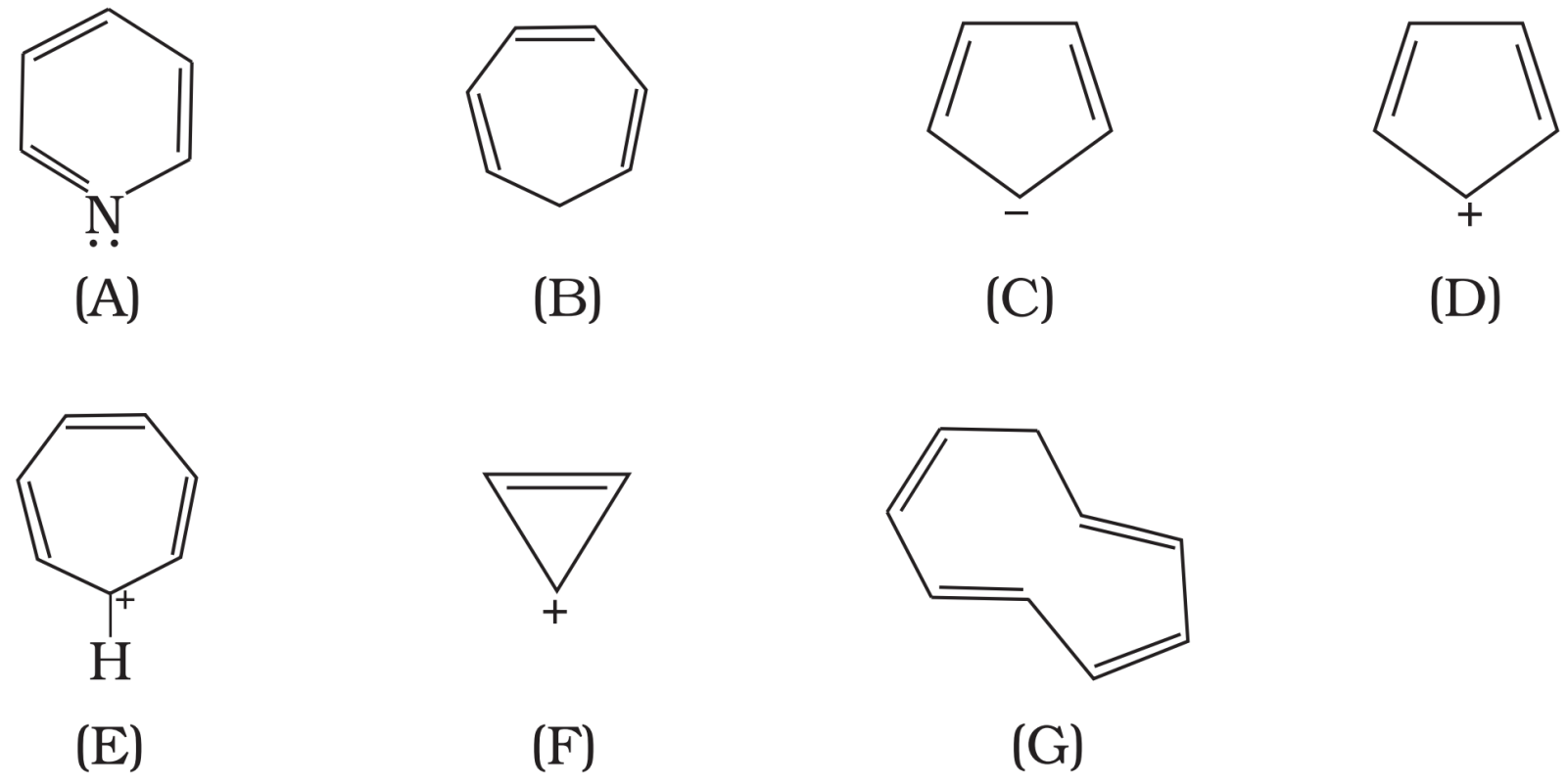
A = Planar ring, all atoms of the ring sp2 hybridised, has six delocalised $\pi$-electrons, follows Huckel rule. It is aromatic.
B = Has six $\pi$-electrons, but the delocalisation stops at sp3 hybridised CH2- carbon. Hence, not aromatic.
C = Six delocalised $\pi$-electrons (4$\pi$ electrons +2 unshared electrons on negatively charged carbon) in a planar ring, follows Huckel’s rule. It is aromatic.
D = Has only four delocalised $\pi$-electrons. It is non aromatic.
E = Six delocalised $\pi$-electrons follows Huckel’s rule. $\pi$-electrons are in sp2 hybridised orbitals, conjugation all over the ring because of positively charged carbon. The ring is planar hence is aromatic.
F = Follows Huckel’s rule, has $2\pi$ electrons i.e. (4n + 2) $\pi$-electrons where (n = 0), delocalised $\pi$-electrons. It is aromatic.
G = $8\pi$ electrons, does not follow Huckel’s rule i.e., (4n + 2) $\pi$-electrons rule. It is not aromatic.

Need a full question paper?

Generate a complete, print-ready paper with questions like this in minutes — across 16+ boards, with answer keys.
Start Generating Free

Similar questions

Depict the galvanic cell in which the reaction Zn(s) + 2Ag+(aq) → Zn2+(aq) + 2Ag(s) takes place, Further show:

The carriers of the current in the cell.

Write molecular orbital configuration of O2. Predict its magnetic behaviour and calculate its bond order.
For the reaction at 298 K ,
$
\begin{array}{c}
2 A+B \rightarrow C \\
\Delta H=400 kJ mol^{-1} \text { and } \Delta S=0.2 kJ K^{-1} mol^{-1}
\end{array}
$
At what temperature will the reaction become spontaneous considering $\Delta H$ and $\Delta S$ to be constant over the temperature range.
In $\text{NO}^-_3$ ion, the number of bond pairs and lone pairs of electron on nitrogen atom are:
The threshold frequency v, for a metal is 7.0 × 10¹⁴s-1. Calculate the kinetic energy of an electron emitted when radiation of v = 1.0 × 10¹⁵s-1 hits the metal.
What is meant by delocalization.
(a) But-2-ene have two geometrical isomers while but-1-ene not why?
(b) A compound having two carbon atoms decolourises Bayer's reagent but do not react with ammonium silver nitrate. Name the compound.
Conjugate acid of a weak base is always stronger. What will be the decreasing order of basic strength of the following conjugate bases?
$\text{OH}^–,\text{ RO}^–,\text{ CH}_3\text{COO}^–,\text{ Cl}^–$
Which is more informative? Empirical or molecular formula?
What is the total number of sigma and pi bond in the following molecules?
  1. $\text{C}_2\text{H}_3\text{Cl}$
  2. $\text{C}_4\text{H}_4\text{Cl}_2$
  3. $\ \ \ \ \ \ \ \ \ \ \ \ \ {\text{H}\ \ \ \ \text{H}}\\\ \ \ \ \ \ \ \ \ \ \ \ \ |\ \ \ \ \ \ \ |\\ \text{H}_3\text{C}-\text{C}=\text{C}-\text{C}\equiv\text{C}-\text{H}$