Question
The saturation current in a triode valve can be changed by changing:
  1. The grid voltage.
  2. The plate voltage.
  3. The separation between the grid and the cathode.
  4. The temperature of the cathode.

Answer

  1. The grid voltage.
Explanation:

Since the triode value consists of a space charge region near the cathode, this space charge region is affected by the grid voltage. If the grid voltage is made negative, it repels the electrons coming from the cathode and reduces current. If this voltage is made positive, it helps the electrons move towards the anode. Hence, this voltage is more effective in changing the plate current. Since, the saturated current in the triode is the maximum value of plate current, the saturated current in the triode valve is effectively controlled by the grid voltage. More negative is the grid voltage, less is the value of saturated current.

Need a full question paper?

Generate a complete, print-ready paper with questions like this in minutes — across 16+ boards, with answer keys.

Start Generating Free

Similar questions

A kid of mass M stands at the edge of a platform of radius R which can be freely rotated about its axis. The moment of inertia of the platform is I. The system is at rest when a friend throws a ball of mass m and the kid catches it. If the velocity of the ball is v horizontally along the tangent to the edge of the platform when it was caught by the kid, find the angular speed of the platform after the event.
The half-life of ${ }^{226} \mathrm{Ra}$ is 1602 y . Calculate the activity of 0.1 g of $\mathrm{RaCl}_2$ in which all the radium is in the form of ${ }^{226} \mathrm{Ra}$. Taken atomic weight of Ra to be $226 \mathrm{~g} / \mathrm{mol}^{-1}$ and that of Cl to be $35.5 \mathrm{~g} / \mathrm{mol}^{-1}$.
Suppose the bent part of the frame of the previous problem has a thermal conductivity of $780 \mathrm{Js}^{-1} \mathrm{~m}^{-1°} \mathrm{C}^{-1}$ whereas it is $390 \mathrm{Js}^{-1} \mathrm{~m}^{-1°} \mathrm{C}^{-1}$ for the straight part. Calculate the ratio of the rate of heat flow through the bent part to the rate of heat flow through the straight part.
Two submarines are approaching each other in a calm sea. The first submarine travels at a speed of $36km/h$ and the other at $54km/h$ relative to the water. The first submarine sends a sound signal (sound waves in water are also called sonar) at a frequency of $2000Hz$.
  1. At what frequency is this signal received by the second submarine?
  2. The signal is reflected from the second submarine. At what frequency is this signal received by the first submarine. Take the speed of the sound wave in water to be $1500m/s$.
Read the passage given below and answer the following questions from 1 to 5.
Beats is an interesting phenomenon arising from interference of waves. When two harmonic Sound waves of slightly different frequencies and comparable amplitude are heard at the same time, we hear a sound of similar frequency (the average of two close frequencies), but we hear something else also. We hear audibly distinct waxing and waning of the intensity of the sound, with a frequency equal to the difference in the two close frequencies. Beat frequency is given by
$u = u_1 - u_2$
Artists use this phenomenon often while tuning their instruments with each other. They go on tuning until their sensitive ears do not detect any beats.
Doppler Effect is a wave phenomenon, it holds not only for sound waves but also for electromagnetic waves. However, here we shall consider only sound waves. Doppler Effect is defined as increase or decrease in frequency of sound due to relative motion between source of sound and observer. Frequency increases when source and observer comes towards each other and frequency decreases when source and observer go away from each other .For sound the observed frequency n is given in terms of the source frequency $v_0$ by
$\text{u}=\text{v}_0\frac{\text{v}+\text{v}_0}{\text{v}+\text{vs}}$
Here v is the speed of sound through the medium, is the velocity of observer relative to the medium, and is the source velocity relative to the medium. In using this formula, velocities in the direction OS should be treated as positive and those opposite to it should be taken to be negative. The change in frequency caused by a moving object due to Doppler Effect is used to measure their velocities in diverse areas such as military, medical science, astrophysics, etc. It is also used by police to check over-speeding of vehicles. A sound wave or electromagnetic wave of known frequency is sent towards a moving object. Some part of the wave is reflected from the object and its frequency is detected by the monitoring station. This change in frequency is called Doppler shift. It is used at airports to guide aircraft, and in the military to detect enemy aircraft. Astrophysicists use it to measure the velocities of stars. Doctors use it to study heart beats and blood flow in different parts of the body. Here they use ultrasonic waves, and in common practice, it is called sonography. Ultrasonic waves enter the body of the person, some of them are reflected back, and give information about motion of blood and pulsation of heart valves, as well as pulsation of the heart of the foetus. In the case of heart, the picture generated is called echocardiogram. Answer the following
  1. Beats are heard after superposition of two waves with beat frequency.
  1. $υ = υ_1 - υ_2$
  2. $υ = υ_1 + υ_2$
  3. $υ = (υ_1 - υ_2)/_2$
  4. None of these
  1. When source and observer comes towards each other then frequency heard will.
  1. Increase
  2. Decrease
  3. Remains same
  4. None of these
  1. Define beats.
  1. Define Doppler effect in sound.
  1. Note on applications of Doppler Effect in sound.
Read the passage given below and answer the following questions from i to v. If an object moving along the straight line covers equal distances in equal intervals of time, it is said to be in uniform motion along a straight line. Distance and displacement are two quantities that seem to mean the same but are different with different meanings and definitions. Distance is the measure of actual path length travelled by object. It is scalar quantity having SI unit of metre while displacement refers to the shortest distance between initial and final position of object. It is vector quantity. The magnitude of the displacement for a course of motion may be zero but the corresponding path length is not zero. using this data answer following questions.
  1. Can path length be zero for motion of body from one point to other point?
  1. Yes
  2. No
  1. For any given motion from point A to B, displacement =10m and distance = 5m. Is it possible?
  1. Yes
  2. No
  1. For rectilinear motion displacement can be
  1. Positive only
  2. Negative only
  3. Can be zero
  4. All of the above
  1. Define distance and displacement of particle.
  1. Write difference between distance and displacement.
A metallic loop is placed in a nonuniform magnetic field. Will an emf be induced in the loop?
An elevator is descending with uniform acceleration. To measure the acceleration, a person in the elevator drops a coin at the moment the elevator starts. The coin is 6ft above the floor of the elevator at the time it is dropped. The person observes that the coin strikes the floor in 1 second. Calculate from these data the acceleration of the elevator.
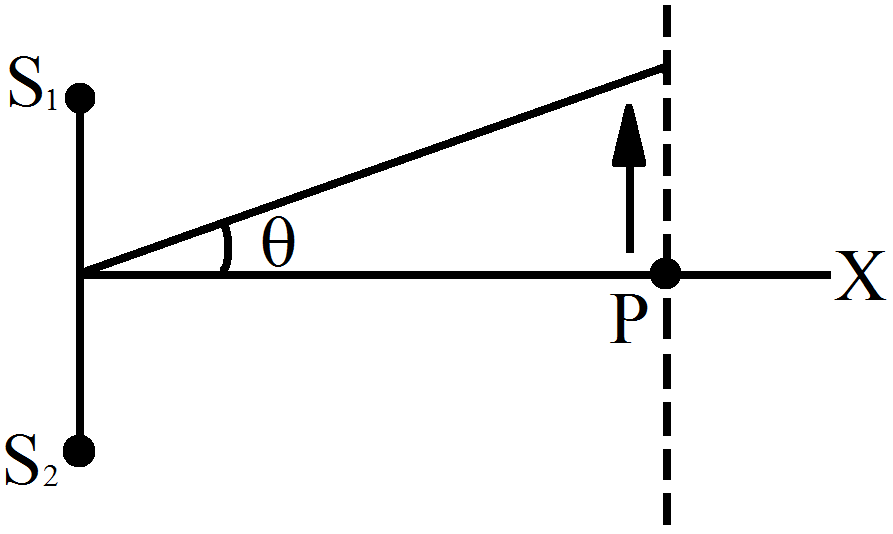
Two speakers $S_1$ and $S_2$, driven by the same amplifier, are placed at $y = 1.0m$ and $y = -1.0m$ figure, The speakers vibrate in phase at $600Hz$. A man stands at a point on the X-axis at a very large distance from the origin and starts moving parallel to the Y-axis. The speed of sound in air is $330m/s$.
  1. At what angle $\theta$ will the intensity of sound drop to a minimum for the first time?
  2. At what angle will he hear a maximum of sound intensity for the first time?
  3. If he continues to walk along the line, how many more maxima can he hear?
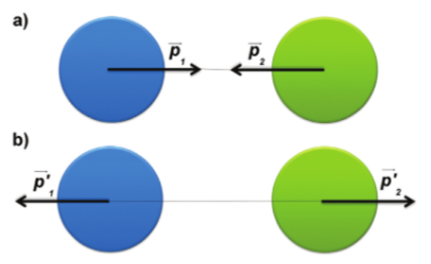
The kinetic energy of an object is the energy associated with the object which is under motion. It is defined as "the energy required by a body to accelerate from rest to stated velocity." It is a vector quantity and the momentum of an object is the virtue of its mass. It is defined as the product of mass and velocity. It is a vector quantity. The relation between them is given by $E =\frac{P^2}{2 m}$. In case of the elastic collision both of these quantities remain constant.
Image
1.Two masses of 1 gm and 4 gm are moving with equal linear momentum. The ratio of their kinetic energy is:
(a) $1: 2$ (b) $4: 1$ (c) $1: 1$ (d) $4: 2$
2. If the linear momentum is increased by $50 \%$, then K .E will be increased by:
(a) $50 \%$ (b) $200 \%$ (c) $125 \%$ (d) $100 \%$
3.A heavy object and a light object have the same momentum. Which has the greater speed?
(a) both heavy and light object
(b) heavy object
(c) Moderate object
(d) light object
OR
Kinetic energy with any reference must be $\qquad$
(a) Change (b) negative (c) zero (d) positive
4.When a body moves with a constant speed along a circle then
(a) no acceleration is produced
(b) no work is done on it
(c) no displacement on it
(d) no force acts on it