Question
The separation between the consecutive dark fringes in a Young's double slit experiment is $1.0\ mm.$ The screen is placed at a distance of $2.5m$ from the slits and the separation between the slits is $1.0\ mm.$ Calculate the wavelength of light used for the experiment.
Answer

Given that, $\beta=1\text{mm}=10^{-3}\text{m}, $
$D = 2.5m$ and $d = 1\ mm = 10^{-3}m$
So, $10^{-3}\text{m}=\frac{25\times\lambda}{10^{-3}}$
$\Rightarrow\lambda=4\times10^{-7}\text{m}$
$=400\ \text{nm}.$

Need a full question paper?

Generate a complete, print-ready paper with questions like this in minutes — across 16+ boards, with answer keys.

Start Generating Free

Similar questions

An electric current of 2.0A passes through a wire of resistance $25\Omega$. How much heat will be developed in 1minute?
Each side of a square is 90 cm long. At its corners $-2,+3,-4$ and +5 micro coulomb charges are placed respectively. Find the electric potential at the centre of the square.
A proton and a deuteron are accelerated through the same accelerating potential. Which one of the two has,
  1. greater value of de$-$Broglie wavelength associated with it, and
  2. less momentum?
Give reasons to justify your answer.
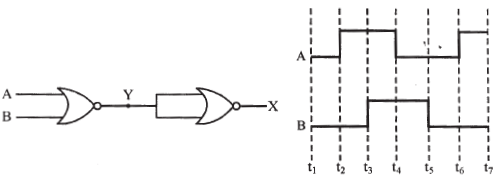
Draw the output waveform at X, using the given inputs A and B for the logic circuit shown below. Also, identify the logic operation performed by this circuit.
An optical fibre $(\mu=1.72)$ is surrounded by a glass coating $(\mu=1.50).$ Find the critical angle for total internal/ reflection at the fibre-glass interface.
Use de$-$ Broglie’s hypothesis to write the relation for the nth radius of Bohr orbit in terms of Bohr’s quantization condition of orbital angular momentum.
A copper wire of cross $-$ sectional area $0.01\ cm^2$ is under a tension of $20N$. Find the decrease in the cross $-$ sectional area. Young's modulus of copper $= 1.1 \times 10 ^{11}N/m^2$ and Poisson's ratio $=\  0.32.\Big  [$Hint: $\frac{\triangle\text{A}}{\text{A}}=2\frac{\triangle\text{r}}{\text{r}}\Big]$
Show that if the room temperature changes by a small amount from T to $\text{T}+\triangle\text{T},$ the fundamental frequency of an organ pipe changes from v to $\text{v}+\triangle\text{v},$ where-$\frac{\triangle\text{v}}{\text{v}}=\frac{1}{2}\frac{\triangle\text{T}}{\text{T}}.$
Answer the following question:
When viewing through a compound microscope, our eyes should be positioned not on the eyepiece but a short distance away from it for best viewing. Why? How much should be that short distance between the eye and eyepiece?
Two metallic wires of the same material have the same length but cross-sectional areas are in the ratio 1 : 2. They are connected (i) in series and (ii) in parallel. Compare the drift velocities of electrons in the two wires in both the cases (i) and (ii).