Question
The separation between the objective and the eyepiece of a compound microscope can be adjusted between 9.8cm to 11.8cm. If the focal lengths of the objective and the eyepiece are 1.0cm and 6cm respectively, find the range of the magnifying power if the image is always needed at 24cm from the eye.

Answer

For the given compound microscope

f0 = 1cm, fe = 6cm, D = 24cm

For the eye piece, ve = -24cm, fe = 6cm

Now, $\frac{1}{\text{v}_\text{e}}-\frac{1}{\text{u}_\text{e}}=\frac{1}{\text{f}_\text{e}}$

$\Rightarrow\frac{1}{\text{u}_\text{e}}=\frac{1}{\text{v}_\text{e}}-\frac{1}{\text{f}_\text{e}}\Rightarrow-\Big[\frac{1}{24}+\frac{1}{6}\Big]=-\frac{5}{24}$

$\Rightarrow \text{u}_\text{e}=-4.8\text{cm}$

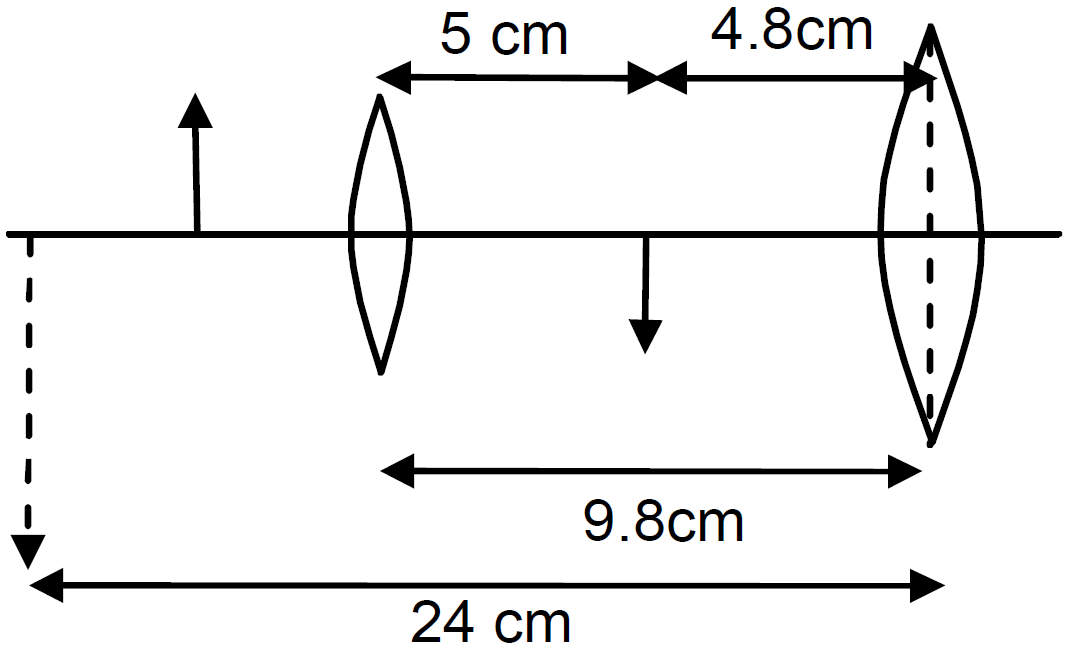
  1. When the separation between objective and eye piece is 9.8cm, the image distance for the objective lens must be (9.8) - (4.8) = 5.0cm

Now, $\frac{1}{\text{v}_0}-\frac{1}{\text{u}_0}=\frac{1}{\text{f}_0}$

$\Rightarrow\frac{1}{\text{u}_0}=\frac{1}{\text{v}_0}-\frac{1}{\text{f}_0}=\frac{1}{5}-\frac{1}{1}=-\frac{4}{5}$

$\Rightarrow\text{u}_0=-\frac{5}{4}=-1.25\text{cm}$

So, the magnifying power is given by,

$\text{m}=\frac{\text{v}_0}{\text{u}_\text{0}}\Big[1+\frac{\text{D}}{\text{f}}\Big]=\frac{-5}{-1.25}\Big[1+\frac{24}{6}\Big]=4\times5=20$
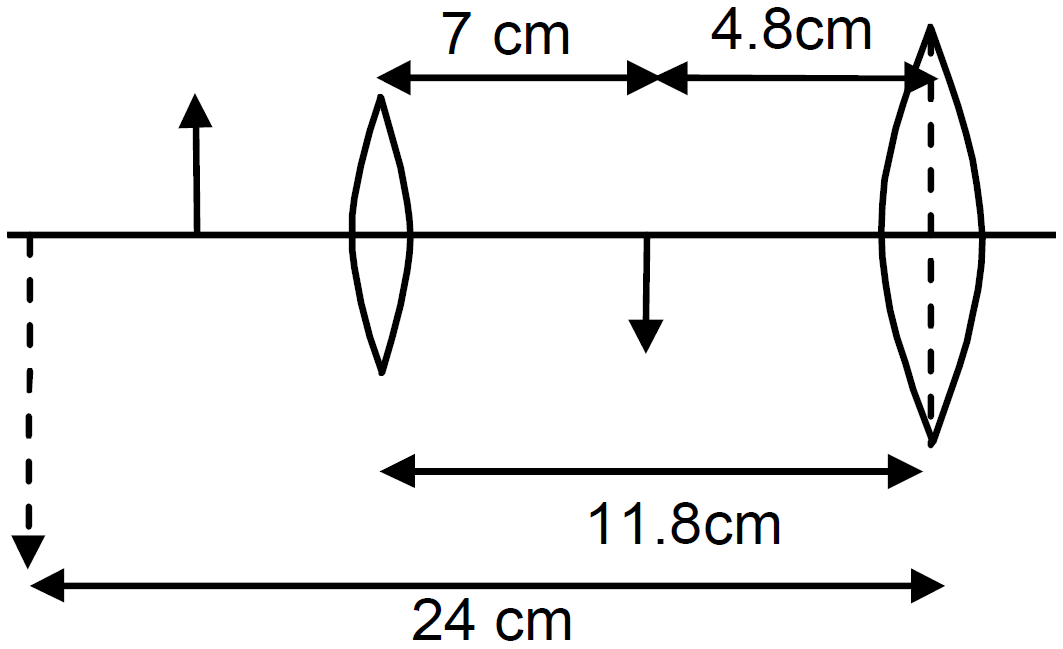
  1.  When the separation is 11.8cm,

v0 = 11.8 - 4.8 = 7.0cm, f0 = 1cm

$\Rightarrow\frac{1}{\text{u}_0}=\frac{1}{\text{v}_0}-\frac{1}{\text{f}_0}=\frac{1}{7}-\frac{1}{1}=-\frac{6}{7}$

So, $\text{m}=-\frac{\text{v}_0}{\text{u}_\text{o}}\Big[1+\frac{\text{D}}{\text{f}}\Big]=\frac{-7}{-\Big(\frac{7}{6}\Big)}\Big[1+\frac{24}{6}\Big]=6\times5=30$

So, the range of magnifying power will be 20 to 30.
Need a full question paper?

Generate a complete, print-ready paper with questions like this in minutes — across 16+ boards, with answer keys.

Start Generating Free

Similar questions

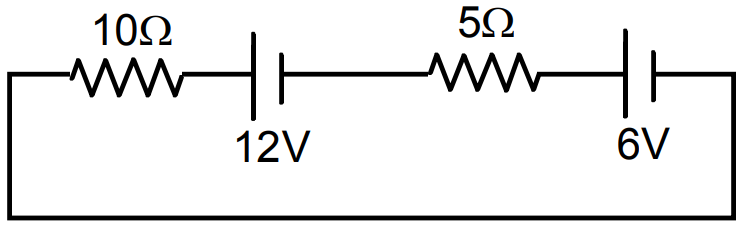
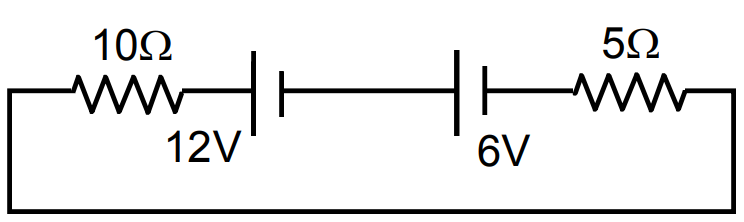
Consider the circuit shown in the figure. Find (a) the current in the circuit (b) the potential drop across the $5\Omega$ resistor (c) the potential drop across the $10\Omega$ resistor. (d) Answer the parts (a), (b) and (c) with reference to the figure.


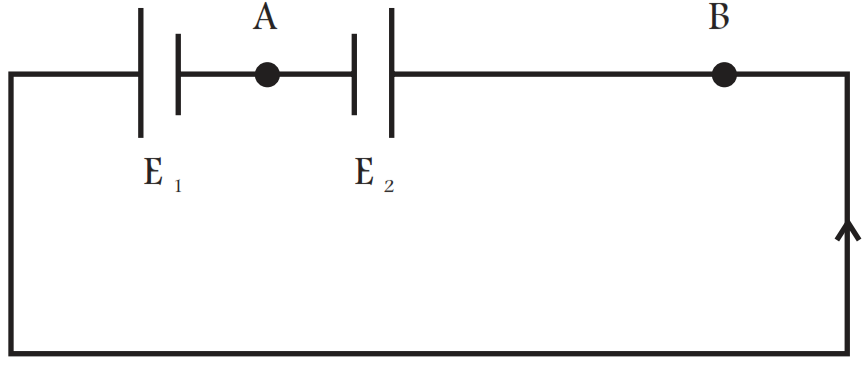
The circuit in Fig. shows two cells connected in opposition to each other. Cell E1 is of emf 6V and internal resistance 2Ω; the cell E2 is of emf 4V and internal resistance 8Ω. Find the potential difference between the points A and B.

Which one of the following cannot emit radiation and why? Excited nucleus, excited electron.
A bucket full of water is placed in a room at 15°C with initial relative humidity 40%. The volume of the room is 50m3.
  1. How much water will evaporate?
  2. lf the room temperature is increased by 5°C, how much more water will evaporate? The saturation vapour pressure of water at 15°C and 20°C are 1.6kPa and 2.4kPa respectively.
Can the work by kinetic friction on an object be positive? Zero?
A capacitor of capacitance $2.0\mu\text{F}$ is charged to a potential difference of 12V. It is then connected to an uncharged capacitor of capacitance $4.0\mu\text{F}$ as shown in figure. Find:
  1. The charge on each of the two capacitors after the connection.
  2. The electrostatic energy stored in each of the two capacitors.
  3. The heat produced during the charge transfer from one capacitor to the other.

Derive an expression for magnetic field intensity due to a magnetic dipole at a point on its axial line.
A small particle travelling with a velocity u collides elastically with a spherical body of equal mass and of radius r initially kept at rest. The centre of this spherical body is located a distance (p < r) away from the direction of motion of the particle. Find the final velocities of the two particles.

[Hint: The force acts along the normal to the sphere through the contact. Treat the collision as onedimensional for this direction. In the tangential direction no force acts and the velocities do not change].
Ram is a  student of class X in a village school. His uncle gifted him a bicycle with a dynamo fitted in it. He was very excited to get it. While cycling during night, he could light the bulb and see the objects on the road. He however, did not know this device works. He asked this question to his teacher. the teacher considered it an opportunity to explain the working to the whole class.
Answer the following question:
  1. State the principle and working of a dynamo.
  2. Write two values each displayed by Ram and his school teacher.