MCQ
The separation between two microscopic particles is measured ${P_A}$ and ${P_B}$ by two different lights of wavelength $2000 \;\mathring A $ and $3000 \;\mathring A $ respectively, then
  • A
    ${P_A} > {P_B}$
  • ${P_A} < {P_B}$
  • C
    ${P_A} < \frac{{3}}{{2}} {P_B}$
  • D
    ${P_A} = {P_B}$

Answer

Correct option: B.
${P_A} < {P_B}$
b
Resolving limit (minimum separation)$ \propto \lambda $

$ \Rightarrow \frac{{{P_A}}}{{{P_B}}} = \frac{{2000}}{{3000}} \Rightarrow {P_A} < {P_B}$

Need a full question paper?

Generate a complete, print-ready paper with questions like this in minutes — across 16+ boards, with answer keys.

Start Generating Free

Similar questions

When a resistance of $5\,\Omega$ is shunted with a moving coil galvanometer, it shows a full scale deflection for a current of $250\,mA$, however when $1050\,\Omega$ resistance is connected with it in series, it gives full scale deflection for $25$ volt. The resistance of galvanometer is $......\,\Omega$.
At what angle should an unpolarised beam be incident on a crystal of $\mu = \sqrt 3$ , so that reflected beam is polarised ..........$^o$
Thermionic emission from a heated filament varies with its temperature $T$ as
Rest mass energy of an electron is 0.54 MeV. If velocity of the electron is 0.8 c, then K.E. of the electron is
Direction of the first secondary maximum in the Fraunhofer diffraction pattern at a single slit is given by ($a$ is the width of the slit)
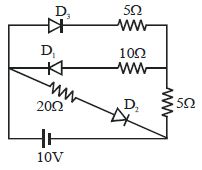
In the given circuit The current through the battery is........$A$
The time period of rotation of the sun is 25 days and its radius is $7\times 10^8$ m. The Doppler shift for the light of wavelength 6000 Å emitted from the surface of the sun will be
The resistor of resistance '$R$' is connected to $25\, V$ supply and heat produced in it is $25\, J/sec$. The value of $R$ is .......... $\Omega $
The intensity of the electric field required to keep a water drop of radius $10^{-5}$ Cm just suspended in air when charged with one electron is approximately (g = 10 newton/kg e = $1.6\times 10^{-19}$ coulomb) 
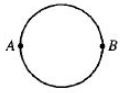
A wire of resistance $12\,ohms$ per meter is bent to form a complete circle of radius $10\, cm.$ The resistance between its two diametrically opposite points, $A$ and $B$ as shown in the figure is