Question
The sides of certain triangles are given below. Determine them are right triangles:
$7\ cm, 24\ cm, 25\ cm.$

Answer

For a given triangle to be a right angled, the sum of the squares of the two sides must be equal to the square of the largest side.
Let $a = 7\ cm, b = 24\ cm$ and $c = 25\ cm$, Then
$\big(\text{a}^2+\text{b}^2\big)=\big[7^2+(24)^2\big]\text{cm}^2$
$=(49+576)\text{cm}^2$
$=625\text{cm}^2$
$\text{c}^2=(25\text{cm})^2=625\text{cm}^2$
$\therefore\big(\text{a}^2+\text{b}^2\big)-\text{c}^2$
Hence, the given triangle is a right triangle.

Need a full question paper?

Generate a complete, print-ready paper with questions like this in minutes — across 16+ boards, with answer keys.

Start Generating Free

Similar questions

Solve the following quadratic equations by factorization:

$\frac{\text{a}}{\text{x}-\text{a}}+\frac{\text{b}}{\text{x}-\text{b}}=\frac{2\text{c}}{\text{x}-\text{c}}$
The hypotenuse of a right is $3\sqrt{10}\text{cm}.$ If the smaller leg is tripled and the longer leg doubled, new hypotenuse will be $9\sqrt{5}\text{cm}.$ How long are the legs of the triangle?
From a point on a bridge across a river, the angles of depression of the banks on opposite sides of the river are $30^\circ $ and $45^\circ $ resbectively. If the bridge is at a height of $2.5\ m$ from the banks, find the width of the river.$\big[\text{Take}\sqrt{3}=1.732\big]$
Show that every positive odd integer is of the form $(4 q+1)$ or $(4 q+3)$ for some integer $q$.
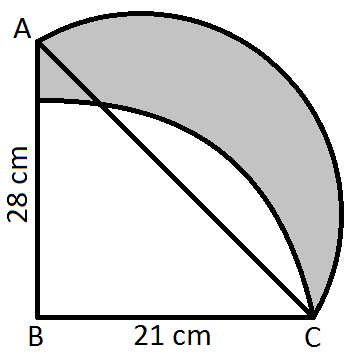
In the following figure, $ABC$ is a right-angled triangle,$\angle\text{B}=90^\circ,$ $AB = 28\ cm$ and $BC = 21\ cm$. With $AC$ as diameter a semicircle is drawn and with $BC$ as radius a quarter circle is drawn. Find the area of the shaded region correct to two decimal places.
A hollow sphere of external and internal diameters $8\ cm$ and $4\ cm$, respectively is melted into a solid cone of base diameter $8\ cm$. Find the height of the cone.
Solve for $x$ and $y:$
$\frac{5}{\text{x}}-\frac{3}{\text{y}}=1,$
$\frac{3}{\text{2x}}+\frac{2}{\text{3y}}=\text{5}$ $(\text{x}\neq0,\ \text{y}\neq0).$
Determine k so that $(3k - 2), (4k - 6)$ and $(k + 2)$ are three consecutive terms of an $AP.$
The first and last terms of an $AP$ are a and l respectively. Show that the sum of the $n^{th}$ term from the beginning and the $n^{th}$ term from the end is $(a + l).$
The $6^{\text {th }}$ and $17^{\text {th }}$ terms of an $A.P.$ are $19$ and $41$ respectively, find the $40^{\text {th }}$ term?