Question
The slits in a Young's double slit experiment have equal width and the source is placed symmetrically with respect to the slits. The intensity at the central fringe is I0. If one of the slits is closed, the intensity at this point will be:

  1. $\text{I}_0$

  2. $\frac{\text{I}_0}{4}$

  3. $\frac{\text{I}_0}{2}$

  4. $4\text{I}_0$

Answer

  1. $\frac{\text{I}_0}{4}$

Explanation:

Total intensity coming from the source is Iwhich is present at the central maxima. In case of two slits, the intensity is getting distributed between the two slits and for a single slit, the amplitude of light coming from the slit is reduced to half which leads to $\frac{1}{4}\text{th}$ of intensity.

Need a full question paper?

Generate a complete, print-ready paper with questions like this in minutes — across 16+ boards, with answer keys.

Start Generating Free

Similar questions

Two particles P and Q describe S.H.M. of same amplitude $a$, same frequency $f$ along the same straight line. The maximum distance between the two particles is a $\sqrt{2}$.The initial phase difference between the particle is -
A wave is represented by the equation $y = 0.5\sin (10t - x)m$. It is a travelling wave propagating along the $+ x$ direction with velocity  .... $m/s$
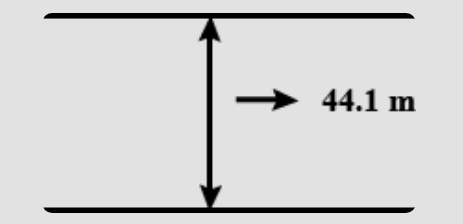
A stone is dropped into the water from a bridge 44.1m above the water. another stone is thrown vertically downward 1second later. both strike the water simultaneously. then initial speed of the second stone is:

Dimension of $\frac{1}{\mu_0 \varepsilon_0}$ should be equal to
Two strings $X$ and $Y$ of a sitar produce a beat frequency $4 Hz$. When the tension of the string $Y$ is slightly increased the beat frequency is found to be $2 Hz.$ If the frequency of $X$ is $300 Hz,$ then the original frequency of $Y$ was .... $Hz$
A bullet is fired from a cannon with velocity $500 \,m/s$. If the angle of projection is ${15^o}$ and $g = 10m/{s^2}$. Then the range is
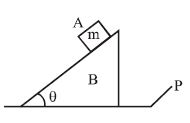
In the figure shown $'P'$ is a plate on which a wedge $B$ is placed and on $B$ a block $A$ of mass $m$ is placed. The plate is suddenly removed and system of $B$ and $A$ is allowed to fall under gravity. Neglecting any force due to air on $A$ and $B$, the normal force on $A$ due to $B$ is
A particle of mass $m$ starts moving from origin along $x$-axis and its velocity varies with position $(x)$ as $v=k \sqrt{x}$. The work done by force acting on it during first " $t$ " seconds is ...........
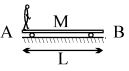
The figure shows a man of mass $m$ standing at the end $A$ of a trolley of mass $M$ placed at rest on a smooth horizontal surface. The man starts moving towards the end $B$ with a velocity $u_{rel}$ with respect to the trolley. The length of the trolley is $L$. As the man walks on the trolley, the centre of mass of the system (man $+$ trolley)
A car moves a distance of $200 \;m$. It covers the first half of the distance at speed $40 \;km / h$ and the second half of distance at speed $v$. The average speed is $48\; km / h$. The value of $v$ is