Question
The source of electromagnetic waves can be a charge:

Answer

  1. Moving in a circular orbit.
  1. falling in an electric field.
Solution:
Key concept:
  1. An electromagnetic wave can be produced by accelerated or oscillating charge.
  2. An oscillating charge is accelerating continuously, it will radiate electromagnetic waves continuously.
  3. Electromagnetic waves are also produced when fast moving electrons are suddenly stopped by a metal target of high atomic number.
Here, in option (b) charge is moving in a circular orbit.
In circular motion, the direction of the motion of charge is changing continuously, thus it is an accelerated motion and this option is correct.
In option (d), the charge is falling in electric field. If a charged particle is moving in electric field it experiences a force or we can say it accelerates. We know an accelerating charge particle radiates electromagnetic waves. Hence option (d) is also correct.
Also, we know that a charge starts accelerating when it falls in an electric field.
Important points:
  1. In an atom an electron is circulating around the nucleus in a stable orbit, although accelerating does not emit electromagnetic waves; it does so only when it jumps from a higher energy orbit to a lower energy orbit.
  2. A simple LC oscillator and energy source can produce waves of desired frequency
Need a full question paper?

Generate a complete, print-ready paper with questions like this in minutes — across 16+ boards, with answer keys.

Start Generating Free

Similar questions

Which of the following is found in the UV region of the spectrum?
The plate current in a triode is given by $I _{ p }=0.004\left(V_{ p }+10 V_{ g }\right)^{3 / 2} mA$ where $I _{ p }, V _{ p }$ and $V _{ g }$ are the values of plate current, plate voltage and grid voltage, respectively. What are the triode parameters $\mu, r_p$ and $g_m$ for the operating point at $V_p=120$ volt and $V _{ g }=-2$ volt?
In an ac circuit, phase of current lags the phase of voltage by an angle of $\frac{\pi}{3}$. The component in the circuit is :
As the temperature of hot junction of a thermo‑couple is increased (while cold junction is at constant temperature), the thermo e.m.f.(a) Increases uniformly at constant rate(b) Increases slowly in the beginning and more rapidly at higher temperatures(c) Increases more rapidly in the beginning but less rapidly at higher temperatures(d) In minimum at neutral temperature


A storage battery has e.m.f. 15 volts and internal resistance 0.05 ohm. Its terminal voltage when it is delivering 10 ampere is(a) 30 volts(b) 1.00 volts(c) 14.5 volts(d) 15.5 volts
       
The moment of inertia of a uniform semicircular wire of mass M and radius r about a line perpendicular to the plane of the wire through the centre is:
  1. $\text{Mr}^2$
  2. $\frac{1}{2}\text{Mr}^2$
  3. $\frac{1}4{}\text{Mr}^2$
  4. $\frac{2}{5}\text{Mr}^2$
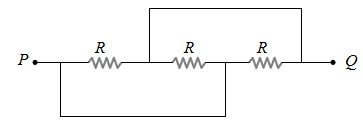
The equivalent resistance between the points $P$ and $Q$ of the circuit given is
The maximum efficiency of full wave rectifier is(a) 100%  (b) 25.20%(c) 40.2% (d) 81.2%
       
When two identical capacitors are in series have $3 \mu F$  capacitance and when parallel $12\mu F. $ What is the capacitance of each
The device, which can be used to detect whether an object is charged, is: