Copper of fixed volume $V$ is drawn into wire of length $l$. When this wire is subjected to a constant force $F$, the extension produced in the wire is $\Delta l$. Which of the following graphs is a straight line?
AIPMT 2014, Easy


Download our appand get started for free
Experience the future of education. Simply download our apps or reach out to us for more information. Let's shape the future of learning together!No signup needed.*
Similar Questions
- 1Under the same load, wire $A$ having length $5.0\,m$ and cross section $2.5 \times 10^{-5}\,m ^2$ stretches uniformly by the same amount as another wire $B$ of length $6.0\,m$ and a cross section of $3.0 \times 10^{-5}\,m ^2$ stretches. The ratio of the Young's modulus of wire $A$ to that of wire $B$ will beView Solution
- 2Two wires $A$ and $B$ of same length and of same material have radii $r_1$ and $r_2$ respectively. Their one end is fixed with a rigid support and at other end equal twisting couple is applied. Then ratio of the angle of twist at the end of $A$ and the angle of twist at the end of $B$ will be ..............View Solution
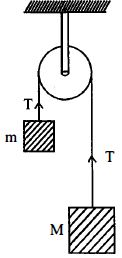
- 3Two blocks of masses $m$ and $M$ are connected by means of a metal wire of cross-sectional area $A$ passing over a frictionless fixed pulley as shown in the figure. The system is then released. If $M = 2\, m$, then the stress produced in the wire isView Solution
- 4Two wires $A$ and $B$ of same length, same area of cross-section having the same Young's modulus are heated to the same range of temperature. If the coefficient of linear expansion of $A$ is $3/2$ times of that of wire $B$. The ratio of the forces produced in two wires will beView Solution
- 5View SolutionThe reason for the change in shape of a regular body is
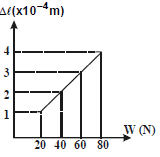
- 6The adjacent graph shows the extension $(\Delta l)$ of a wire of length $1\, m$ suspended from the top of a roof at one end and with a load $W$ connected to the other end. If the cross-sectional area of the wire is $10^{-6}\, m^2$, calculate the Young’s modulus of the material of the wire.View Solution
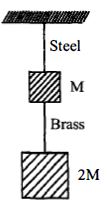
- 7If the ratio of lengths, radii and Young's moduli of steel and brass wires in the figure are $a, b$ and $c$ respectively, then the corresponding ratio of increase in their lengths isView Solution
- 8A $0.1 \mathrm{~kg}$ mass is suspended from a wire of negligible mass. The length of the wire is $1 \mathrm{~m}$ and its crosssectional area is $4.9 \times 10^{-7} \mathrm{~m}^2$. If the mass is pulled a little in the vertically downward direction and released, it performs simple harmonic motion of angular frequency $140 \ \mathrm{rad} \mathrm{s}^{-1}$. If the Young's modulus of the material of the wire is $\mathrm{n} \times 10^9 \mathrm{Nm}^{-2}$, the value of $\mathrm{n}$ isView Solution
- 9A steel rod of length $\ell$, cross sectional area $A$, young's modulus of elasticity $Y$, and thermal coefficient of linear expansion $'a'$ is heated so that its temperature increases by $t\,^oC$. Work that can be done by rod on heating will beView Solution
- 10A cylindrical wire of radius $1\,\, mm$, length $1 m$, Young’s modulus $= 2 × 10^{11} N/m^2$, poisson’s ratio $\mu = \pi /10$ is stretched by a force of $100 N$. Its radius will becomeView Solution