Question
The speed of sound as measured by a student in the laboratory on a winter day is 340m/s when the room temperature is $17^\circ C$. What speed will be measured by another student repeating the experiment on a day when the room temperature is $32^\circ C$?
Answer

$\text{V}_1=330\text{m/s},\ \text{V}_2=?$$\text{T}_1=273+17=290\text{K},\ \text{T}_2=272+32=305\text{K}$
We know $\text{v}\propto\sqrt{\text{T}}$
$\frac{\sqrt{\text{V}_1}}{\sqrt{\text{V}_2}}=\frac{\sqrt{\text{T}_1}}{\sqrt{\text{T}}_2}$
$\Rightarrow\text{v}_2=\frac{\text{V}_1\times\sqrt{\text{T}_2}}{\sqrt{\text{T}_1}}$
$=340\times\sqrt{\frac{305}{290}}=349\text{m/s}$

Need a full question paper?

Generate a complete, print-ready paper with questions like this in minutes — across 16+ boards, with answer keys.

Start Generating Free

Similar questions

Two spheres of the same external radius and made of the same material are heated to the same temperature one of them is hollow and the other is a solid sphere. Whose temperature will fall faster when cooled?
If the frequency of a tuning fork is 400Hz and the velocity of sound in air is 320m/s, find how far does the sound travel when the fork executes 30 vibrations.
Find the maximum Coulomb force that can act on the electron due to the nucleus in a hydrogen atom.
Which of the two will increase the pressure more-an adiabatic or an isothermal process in reducing the volume to 50%?
A heavy particle of mass m falls freely near the earth's surface. What is the torque acting on this particle about a point 50cm east to the line of motion? Does this torque produce any angular acceleration in the particle?
What is called stream line flow?
If a capillary tube is immersed in water in the condition of weightlessness, then how would the rise of water in it be different from the rise of water in normal condition?
A water pipe entering a hose has a dimeter of 2cm and the speed of water is $0.1ms^{-1}$. Eventually, the pipe tapers to a diameter of 1cm. Calculate the speed of water in the tapered portion.
A passenger of mass $72.2\ kg$ is riding in an elevator while standing on a platform scale. What does the scale read when the elevator cab is:
  1. Descending with constant velocity,
  2. Ascending with constant acceleration, $3.5\ m/ s$?
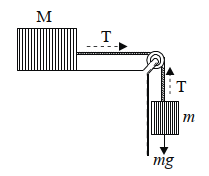
According to the figure, if the coefficient of static friction between block of mass 2 kg and the table is $\mu_s=0.2$ then what should be the maximum value of $m$ so that the block does not move while the pulley is light and frictionless.
Image