The speed of sound in air is independent from its
Easy


Download our appand get started for free
Experience the future of education. Simply download our apps or reach out to us for more information. Let's shape the future of learning together!No signup needed.*
Similar Questions
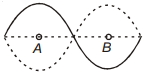
- 1In the standing wave shown, particles at the positions $A$ and $B$ have a phase difference ofView Solution
- 2While measuring the speed of sound by performing a resonance column experiment, a student gets the first resonance condition at a column length of $18\ cm$ during winter. Repeating the same experiment during summer, she measures the column length to be $x\ cm$ for the second resonance. ThenView Solution
- 3View SolutionWhich of the following is not the transverse wave
- 4The ratio of intensities between two coherent sound sources is $4: 1$. The difference of loudness in dB between maximum and minimum intensities when they interfere in the space is ..........View Solution
- 5A man standing on a cliff claps his hand hears its echo after $1 \,sec$. If sound is reflected from another mountain and velocity of sound in air is $340\, m/sec.$ Then the distance between the man and reflection point is ..... $m$View Solution
- 6The ratio of maximum to minimum intensity due to superposition of two waves is $\frac{{49}}{9}$ Then the ratio of the intensity of component waves is .View Solution
- 7Stationary waves are set up in air column. Velocity of sound in air is $330 m/s$ and frequency is $165\,Hz$. Then distance between the nodes is ... $m$View Solution
- 8View SolutionWhen a longitudinal wave propagates through a medium, the particles of the medium execute simple harmonic oscillations about their mean positions. These oscillations of a particle are characterised by an invariant
- 9$16$ tunning forks are arranged in the order of increasing frequencies. Any two successive forks give $8$ beats per sec when sounded together. If the frequency of the last fork is twice the first, then the frequency of the first fork isView Solution
- 10Two travelling waves of equal amplitudes and equal frequencies move in opposite directions along a string. They interfere to produce a stationary wave whose equation is given by $y=\left(10 \cos \pi x \sin \frac{2 \pi t}{T}\right)\, cm$View Solution
The amplitude of the particle at $x =\frac{4}{3} \,cm$ will be........ $cm$.