MCQ
The speed of sound in any gas depends upon
  • A
    Intensity of sound waves only
  • B
    Wavelength of sound only
  • Density and elasticity of gas
  • D
    Amplitude and frequency of sound

Answer

Correct option: C.
Density and elasticity of gas
c
Velocity of sound in any gas depends upon density and elasticity of gas.

Need a full question paper?

Generate a complete, print-ready paper with questions like this in minutes — across 16+ boards, with answer keys.
Start Generating Free

Similar questions

The ratio of angular speeds of minute hand and hour hand of a watch is
A metal wire has mass $(0.4 \pm 0.002)\,g$, radius $(0.3 \pm 0.001)\,mm$ and length $(5 \pm 0.02) \,cm$. The maximum possible percentage error in the measurement of density will nearly be $.......\%$
Given that; $A = B = C$. If $\vec A + \vec B = \vec C,$ then the angle between $\vec A$ and $\vec C$ is $\theta _1$. If $\vec A + \vec B+ \vec C = 0,$ then the angle between $\vec A$ and $\vec C$ is $\theta _2$. What is the relation between $\theta _1$ and $\theta _2$ ?
According to Kepler's third law, square of period of rotation of a planet is:
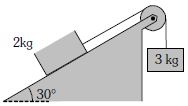
In the arrangement shown, the $2\, kg$ block is held to keep the system at rest. The  string and pulley are ideal. When the $2\, kg$ block is set free, by what amount the  tension in the string changes? $[ g = 10\, m/s^2]$
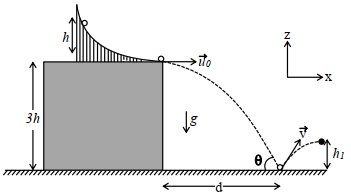
A slide with a frictionless curved surface, which becomes horizontal at its lower end,, is fixed on the terrace of a building of height $3 h$ from the ground, as shown in the figure. A spherical ball of mass $\mathrm{m}$ is released on the slide from rest at a height $h$ from the top of the terrace. The ball leaves the slide with a velocity $\vec{u}_0=u_0 \hat{x}$ and falls on the ground at a distance $d$ from the building making an angle $\theta$ with the horizontal. It bounces off with a velocity $\overrightarrow{\mathrm{v}}$ and reaches a maximum height $h_l$. The acceleration due to gravity is $g$ and the coefficient of restitution of the ground is $1 / \sqrt{3}$. Which of the following statement($s$) is(are) correct?

($AV$) $\vec{u}_0=\sqrt{2 g h} \hat{x}$ ($B$) $\vec{v}=\sqrt{2 g h}(\hat{x}-\hat{z})$  ($C$) $\theta=60^{\circ}$  ($D$) $d / h_1=2 \sqrt{3}$
A long cylindrical vessel is half filled with a liquid. When the vessel is rotated about its own vertical axis, the liquid rises up near the wall. If the radius of vessel is $5\,cm$ and its rotational speed is $2$ rotations per second, then the difference in the heights between the centre and the sides, in $cm,$ will be
At what distance from the centre of the earth, the value of acceleration due to gravity $g$ will be half that on the surface ($R =$ radius of earth)
A body having its centre of mass at the origin has three of its particles at $(a, 0, 0), (0, a, 0), (0, 0, a).$ The moments of inertia of the body about the $X$ and $Y$ axes are $0.20\ \ce{kg-m^2}$ each. The moment of inertia about the $Z-$axis:
A ladder is leaned against a smooth wall and it is allowed to slip on a frictionless floor. Which figure represents trace of its centre of mass?