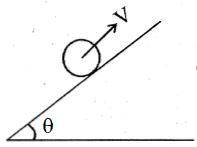
The sphere is performing rolling up an inclined plane, the frictional force is
Medium


Download our appand get started for free
Experience the future of education. Simply download our apps or reach out to us for more information. Let's shape the future of learning together!No signup needed.*
Similar Questions
- 1A block of mass $50 \,kg$ can slide on a rough horizontal surface. The coefficient of friction between the block and the surface is $0.6$. The least force of pull acting at an angle of $30^°$ to the upward drawn vertical which causes the block to just slide is ........ $N$View Solution
- 2A body is moving along a rough horizontal surface with an initial velocity $6\,\,m/s.$ If the body comes to rest after travelling $9\, m$, then the coefficient of sliding friction will beView Solution
- 3$A$ block of mass $M$ is placed on $a$ horizontal surface and it is tied with an inextensible string to $a$ block of mass, as shown in figure. A block of mass $m_0$ is also placed on $M$ If friction force exists between the block $M$ and the block $m_0$ and not between the block $M$ and the horizontal surface, then the minimum value of $\mu$ for which the block m remains stationary isView Solution

- 4The minimum value of $‘F’$ so that block is in equilibrium isView Solution
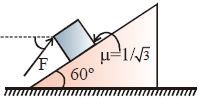
- 5A heavy body of mass $25\, kg$ is to be dragged along a horizontal plane $\left( {\mu = \frac{1}{{\sqrt 3 }}} \right).$ The least force required is ........ $kgf$View Solution
- 6Consider a car moving along a straight horizontal road with a speed of $72\, km/h$. If the coefficient of kinetic friction between the tyres and the road is $0.5,$ the shortest distance in which the car can be stopped is ........ $m$ .$[g = 10\,m{s^{ - 2}}]$View Solution
- 7The maximum tension which an inextensible ring of mass $0.1\, kg/m$ can bear is $10\,N$. The maximum velocity in $m/s$ with which it can be rotated is ........ $m/s.$View Solution
- 8A circular road of radius $1000 \,m$ has banking angle ${45^o}$. The maximum safe speed of a car having mass $2000 \,kg$ will be, if the coefficient of friction between tyre and road is $0.5$ ....... $m/s$View Solution
- 9View SolutionA car is moving with high velocity when it has a turn. A force acts on it outwardly because of
- 10A body of mass $\mathrm{m}$ is kept on a rough horizontal surface (coefficient of friction $=\mu$ ) A horizontal force is applied on the body, but it does not move. The resultant of normal reaction and the frictional force acting on the object is given by $\mathrm{F},$ where $\mathrm{F}$ isView Solution