Consider a car moving along a straight horizontal road with a speed of $72\, km/h$. If the coefficient of kinetic friction between the tyres and the road is $0.5,$ the shortest distance in which the car can be stopped is ........ $m$ .$[g = 10\,m{s^{ - 2}}]$
AIPMT 1992, Medium


Download our appand get started for free
Experience the future of education. Simply download our apps or reach out to us for more information. Let's shape the future of learning together!No signup needed.*
Similar Questions
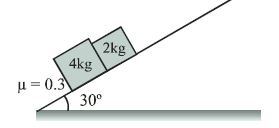
- 1Two blocks, $4\, kg$ and $2\, kg$ are sliding down an inclined plane as shown in figure. The acceleration of $2\, kg$ block is ........ $m/s^2$View Solution
- 2View SolutionChoose the correct statement.
- 3A block of mass $m$ rests on a rough inclined plane. The coefficient of friction between the surface and the block is $\mu$. At what angle of inclination $\theta$ of the plane to the horizontal will the block just start to slide down the plane?View Solution
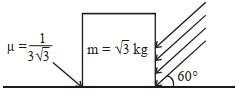
- 4As shown in the figure, a block of mass $\sqrt{3}\, kg$ is kept on a horizontal rough surface of coefficient of friction $\frac{1}{3 \sqrt{3}}$. The critical force to be applied on the vertical surface as shown at an angle $60^{\circ}$ with horizontal such that it does not move, will be $3 x$. The value of $3x$ will beView Solution
$\left[ g =10 m / s ^{2} ; \sin 60^{\circ}=\frac{\sqrt{3}}{2} ; \cos 60^{\circ}=\frac{1}{2}\right]$
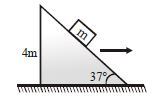
- 5A block of $1\, kg$ is stopped against a wall by applying a force $F$ perpendicular to the wall. If $\mu = 0.2$ then minimum value of $F$ will be ....... $N.$View Solution
- 6A block of mass $10\, kg$ starts sliding on a surface with an initial velocity of $9.8\, ms ^{-1}$. The coefficient of friction between the surface and bock is $0.5$. The distance covered by the block before coming to rest is: [use $g =9.8\, ms ^{-2}$ ].........$m$View Solution
- 7A $2 \mathrm{~kg}$ brick begins to slide over a surface which is inclined at an angle of $45^{\circ}$ with respect to horizontal axis. The co-efficient of static friction between their surfaces is:View Solution
- 8A block of mass $2\,kg$ moving on a horizontal surface with speed of $4\,ms ^{-1}$ enters a rough surface ranging from $x =0.5\,m$ to $x =1.5\,m$. The retarding force in this range of rough surface is related to distance by $F =- kx$ where $k =12\,Nm ^{-1}$. The speed of the block as it just crosses the rough surface will be ........... $\,ms ^{-1}$View Solution
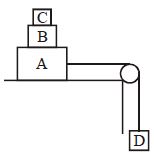
- 9Three blocks $A$, $B$ and $C$ of equal mass $m$ are placed on a smooth surface as shown. Coefficient of friction between any block $A, B$ and $C$ is $μ$. The maximum value of mass $D$ so the block $A, B$ & $C$ move without slipping over each other isView Solution
- 10If the coefficient of friction between block & wedge is $\mu $, then the maximum horizontal acceleration of the wedge for which block will remain at rest w.r.t. the wedge isView Solution