MCQ
The spherical shape of rain-drop is due to
  • A
    Density of the liquid
  • Surface tension
  • C
    Atmospheric pressure
  • D
    Gravity

Answer

Correct option: B.
Surface tension
b
(b) Because of surface tension, a liquid surface tends to have the minimum area possible. And as for a given volume the surface of a sphere has got the minimum area, the rain drops take a spherical shape.

Need a full question paper?

Generate a complete, print-ready paper with questions like this in minutes — across 16+ boards, with answer keys.

Start Generating Free

Similar questions

Molecules of an ideal gas are known to have three translational degrees of freedom and two rotational degrees of freedom. The gas is maintained at a temperature of $T$. The total internal energy, $U$ of a mole of this gas, and the value of $\gamma\left(=\frac{ C _{ P }}{ C _{ v }}\right)$ given, respectively, by
The mean time period of second's pendulum is $2.00s$ and mean absolute error in the time period is $0.05s$. To express maximum estimate of error, the time period should be written as
A series combination of $n_1$ capacitors, each of value $C_1$ is charged by a source of potential difference $4\, V.$ When another parallel combination of $n_2$ capacitors, each of value $C_2,$ is charged by a source of potential difference $V$, it has the same (total) energy stored in it, as the first combination has. The value of $C_2,$ in terms of $C_1$ is then
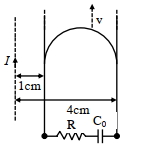
A long straight wire carries a current, $I=2$ ampere. A semi-circular conducting rod is placed beside it on two conducting parallel rails of negligible resistance. Both the rails are parallel to the wire. The wire, the rod and the rails lie in the same horizontal plane, as shown in the figure. Two ends of the semi-circular rod are at distances $1 cm$ and $4 cm$ from the wire. At time $t=0$, the rod starts moving on the rails with a speed $v =3.0 m / s$ (see the figure).

A resistor $R =1.4 \Omega$ and a capacitor $C _0=5.0 \mu F$ are connected in series between the rails. At time $t =0, C _0$ is uncharged. Which of the following statement(s) is(are) correct?

$\left[\mu_0=4 \pi \times 10^{-7}\right.$ SI units. Take $\left.\ln 2=0.7\right]$

$(A)$ Maximum current through $R$ is $1.2 \times 10^{-6}$ ampere

$(B)$ Maximum current through $R$ is $3.8 \times 10^{-6}$ ampere

$(C)$ Maximum charge on capacitor $C _0$ is $8.4 \times 10^{-12}$ coulomb

$(D)$ Maximum charge on capacitor $C _0$ is $2.4 \times 10^{-12}$ coulomb
Maximum force of friction is called
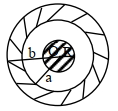
A solid metal sphere of radius $R$ having charge $q$ is enclosed inside the concentric spherical shell of inner radius $a$ and outer radius $b$ as shown in figure. The approximate variation electric field $\overrightarrow{{E}}$ as a function of distance $r$ from centre $O$ is given by
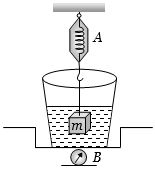
The spring balance $A$ reads $2\, kg$ with a block m suspended from it. $A $ balance $B$ reads $5 \,kg $ when a beaker filled with liquid is put on the pan of the balance. The two balances are now so arranged that the hanging mass is inside the liquid as shown in figure. In this situation
$A$ two eyed man is looking at the junction of two mutually perpendicular mirrors from a far off distance. Assume no reflection to occur from the edge. Then if both the eyes are open
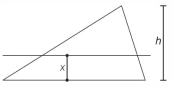
Which one of the following four graphs best depict the variation with $x$ of the moment of inertia $I$ of a uniform triangular lamina about an axis parallel to its base at a distance $x$ from it?
A point source of ligth is used in a photoelectric effect. If the source is removed farther from the emitting metal, the stopping potential :