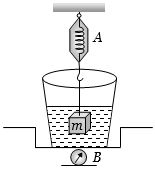
The spring balance $A$ reads $2\, kg$ with a block m suspended from it. $A $ balance $B$ reads $5 \,kg $ when a beaker filled with liquid is put on the pan of the balance. The two balances are now so arranged that the hanging mass is inside the liquid as shown in figure. In this situation
IIT 1985, Medium


Download our appand get started for free
Experience the future of education. Simply download our apps or reach out to us for more information. Let's shape the future of learning together!No signup needed.*
Similar Questions
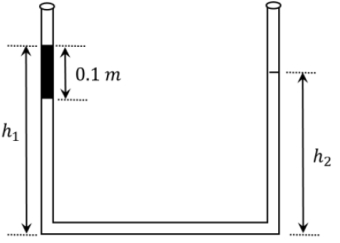
- 1An open-ended U-tube of uniform cross-sectional area contains water (density $10^3 kg m ^{-3}$ ). Initially the water level stands at $0.29 m$ from the bottom in each arm. Kerosene oil (a water-immiscible liquid) of density $800 kg m ^{-3}$ is added to the left arm until its length is $0.1 m$, as shown in the schematic figure below. The ratio $\left(\frac{h_1}{h_2}\right)$ of the heights of the liquid in the two arms is-View Solution
- 2When a rubber ball is taken to a depth of $......\,{m}$ in deep sea, its volume decreases by $0.5\, \%$View Solution
(The bulk modulus of rubber $=9.8 \times 10^{8}\, {Nm}^{-2}$ Density of sea water $=10^{3} {kgm}^{-3}$
$\left.{g}=9.8\, {m} / {s}^{2}\right)$
- 3View SolutionA wooden cylinder floats vertically in water with half of its length immersed. The density of wood is
- 4View SolutionWhich of the following is not the characteristic of turbulent flow
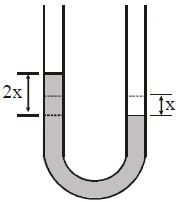
- 5$9\ kg$ of mercury is poured into a glass $U-tube$ with inner diameter of $1.2 \ cm$. The mercury can flow without friction within the tube. the oscillation period ......... $\sec$. Density of mercury = $13.6 × 10^3\ kg/m^3$.View Solution
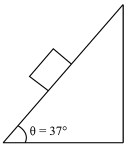
- 6A cubical block of side $‘a’$ and density $‘\rho ’$ slides over a fixed inclined plane with constant velocity $‘v’$. There is a thin film of viscous fluid of thickness $‘t’$ between the plane and the block. Then the coefficient of viscosity of the thin film will be:View Solution
- 7Two capillary tubes of the same length but different radii $r_1 $ and $r_2$ are fitted in parallel to the bottom of a vessel. The pressure head is $ P. $ What should be the radius of a single tube that can replace the two tubes so that the rate of flow is same as beforeView Solution
- 8Water falls down a $500.0 \,m$ shaft to reach a turbine which generates electricity. ................ $m^3$ water must fall per second in order to generate $1.00 \times 10^9 \,W$ of power ? (Assume $50 \%$ efficiency of conversion and $\left.g=10 \,ms ^{-2}\right)$View Solution
- 9View SolutionIn the case of a fluid, Bernoulli's theorem expresses the application of the principle of conservation of :
- 10Two small spherical metal balls, having equal masses, are made from materials of densities $\rho_{1}$ and $\rho_{2}\left(\rho_{1}=8 \rho_{2}\right)$ and have radii of $1\; \mathrm{mm}$ and $2\; \mathrm{mm}$, respectively. They are made to fall vertically (from rest) in a viscous medum whose coefficient of viscosity equals $\eta$ and whose denstry is $0.1 \mathrm{\rho}_{2} .$ The ratio of their terminal velocitites would beView Solution