MCQ
The statement that is $INCORRECT$ about the interstitial compound is
  • A
    they have metallic conductivity
  • B
    they have high melting points
  • they are chemically reactive
  • D
    they are very hard

Answer

Correct option: C.
they are chemically reactive
c
In case of interstial compounds there is presence of small atoms (or impurity) in the lattice of metal. So interstial compounds are hard, high melting point and chemically inert.

Need a full question paper?

Generate a complete, print-ready paper with questions like this in minutes — across 16+ boards, with answer keys.

Start Generating Free

Similar questions

$C{H_3} - CH = C{H_2}\xrightarrow[{hv\,(low\,conc.)}]{{B{r_2}}}\xrightarrow[{Dry\,ether}]{{Mg}}\xrightarrow[{N{H_4}Cl}]{{\begin{array}{*{20}{c}}
  O \\ 
  {||} \\ 
  {C{H_3} - C - C{H_3}} 
\end{array}}}\xrightarrow[\Delta ]{{{H^ + }}}\mathop {(X)}\limits_{(major)} $

End product $(X)$ of the above reaction is

In a compound the ratio of masses of $H,C,O$ and $N$ is $1:3:4:7$. The empirical formula is
Which describes the best stereochemical aspects of the following reaction ?
The following statements concern elements in the periodic table. Which of the following is true ?
Inversion of sucrose is
Diatoms, microscopic organisms, are an abundant food source in the oceans producing carbohydrates from carbon dioxide and water by photosynthesis

$6CO_2 + 6H_2O + solar energy \to C_6H_{12}O_6+6O_2$

A blue whales gain $75\ kg$ of mass per day by feeding on krill. The whale must consume ten times this mass of krill each day. The krill must consume $10.0\ kg$ of diatoms to produce $1.0\ kg$ of krill. Assuming that the mass gain of a whale's life is due to the consumption of carbohydrates $(C_6H_{12}O_6)$ , calculate the moles of $CO_2$ that must be used by the diatoms to produce the carbohydrates consumed by a blue whale in a day

Amongst $LiCl, RbCl, BeCl_2$ and $MgCl_2$ the compounds with the greatest and the least ionic character, respectively are:
When glycerol is heated with $KHS{O_4}$ it gives
The amount of $BaSO_4$ formed upon mixing $100\,mL$ of $20.8\%$ $BaCl_2$ solution with $50\,mL$ of $9.8\%$ $H_2SO_4$ solution will be ............. $\mathrm{g}$

( $Ba = 137,\,\,Cl = 35.5,\,\,S = 32,\,\,H = 1$ and $O = 16$ )

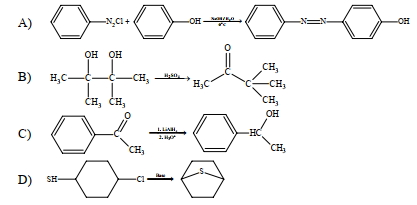
Match the reactions in Column $I$ with appropriate options in Column $II$.
Column $I$ Column $II$
$(A)$ $Image$ $(p)$ Racemic mixture
$(B)$ $Image$ $(q)$ Addition reaction
$(C)$ $Image$ $(r)$ Substitution reaction
$(D)$ $Image$ $(s)$ Coupling reaction
  $(t)$ Carbocation intermediate