MCQ
The stationary reference frame situated on the earth's surface is
  • A
    inertial
  • Non-inertial but can generally be considered inertial
  • C
    Inertial or non inertial according to state
  • D
    Non-inertial

Answer

Correct option: B.
Non-inertial but can generally be considered inertial
B

Need a full question paper?

Generate a complete, print-ready paper with questions like this in minutes — across 16+ boards, with answer keys.
Start Generating Free

Similar questions

A man pushes a wall and fails to displace it. He does
The total energy of a black body radiation source is collected for five minutes and used to heat water. The temperature of the water increases from $10.0^{\circ} C$ to $11.0^{\circ} C$. The absolute temperature of the black body is doubled and its surface area halved and the experiment repeated for the same time. Which of the following statements would be most nearly correct?
Which of the following statements is true regarding the molecular kinetic theory of gases?
The velocity of a particle performing simple harmonic motion, when it passes through its mean position is
In a vessel, the gas is at pressure $P_0$. If the mass of all the molecules is halved and their speed is doubled, then the resultant pressure will be 
A granite rod of $60\ cm$ length is clamped at its middle point and is set into longitudinal vibrations. The density of granite is $2.7 \times 10^3 $ $kg/m^3$ and its Young's modulus is $9.27 \times 10^{10}$ $Pa$ What will be the fundamental frequency of the longitudinal vibrations .... $kHz$ ?
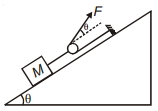
What is the minimum value of $F$ needed so that block begins to move upward on frictionless incline plane as shown
A body is in pure rotation. The linear speed $v$​ of a particle, the distance $r$ of the particle from the axis and angular velocity $\omega $ of the body are related as $\omega  = \frac{v}{r}$, thus
A metallic wire of length $L$ is fixed between two rigid supports. If the wire is cooled through a temperature difference $\Delta T$ ($Y$ = young’s modulus, $\rho$ = density, $\alpha$ = coefficient of linear expansion) then the frequency of transverse vibration is proportional to : 
A body $B$ lies on a smooth horizontal table and another body $A$ is placed on $B$. The coefficient of friction between $A$ and $B$ is $\mu $. What acceleration given to $B$ will cause slipping to occur between $A$ and $B$