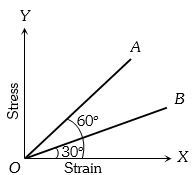
The stress versus strain graphs for wires of two materials $A$ and $B$ are as shown in the figure. If ${Y_A}$ and ${Y_B}$ are the Young ‘s modulii of the materials, then
Medium


Download our appand get started for free
Experience the future of education. Simply download our apps or reach out to us for more information. Let's shape the future of learning together!No signup needed.*
Similar Questions
- 1View SolutionIn materials like aluminium and copper, the correct order of magnitude of various elastic modulii is
- 2A bob of mass $10\, kg$ is attached to wire $0.3\, m$ long. Its breaking stress is $4.8 \times 10^7 N/m^2$. The area of cross section of the wire is $10^{-6} m^2$. The maximum angular velocity with which it can be rotated in a horizontal circle ....... $rad/sec$View Solution
- 3The force required to stretch a steel wire of $1\,c{m^2}$ cross-section to $1.1$ times its length would be $(Y = 2 \times {10^{11}}\,N{m^{ - 2}})$View Solution
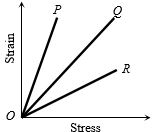
- 4The strain-stress curves of three wires of different materials are shown in the figure. $P, Q$ and $R$ are the elastic limits of the wires. The figure shows thatView Solution
- 5If $\rho $ is the density of the material of a wire and $\sigma $ is breaking stress, the greatest length of the wire that can hang freely without breaking isView Solution
- 6A solid sphere of radius $r$ made of a soft material of bulk modulus $K$ is surrounded by a liquid in a cylindrical container. A massless piston of area $a$ floats on the surface of the liquid, covering entire crosssection of cylindrical container. When a mass $m$ is placed on the surface of the piston to compress the liquid, the fractional decrement in the radius of the sphere, $\left( {\frac{{dr}}{r}} \right)$ isView Solution
- 7View SolutionIf Young's modulus for a material is zero, then the state of material should be
- 8For a given material, the Young's modulus is $2.4$ times that of rigidity modulus. Its Poisson's ratio isView Solution
- 9The length of a rod is $20\, cm$ and area of cross-section $2\,c{m^2}$. The Young's modulus of the material of wire is $1.4 \times {10^{11}}\,N/{m^2}$. If the rod is compressed by $5\, kg-wt$ along its length, then increase in the energy of the rod in joules will beView Solution
- 10View SolutionWhich of the following affects the elasticity of a substance