Question
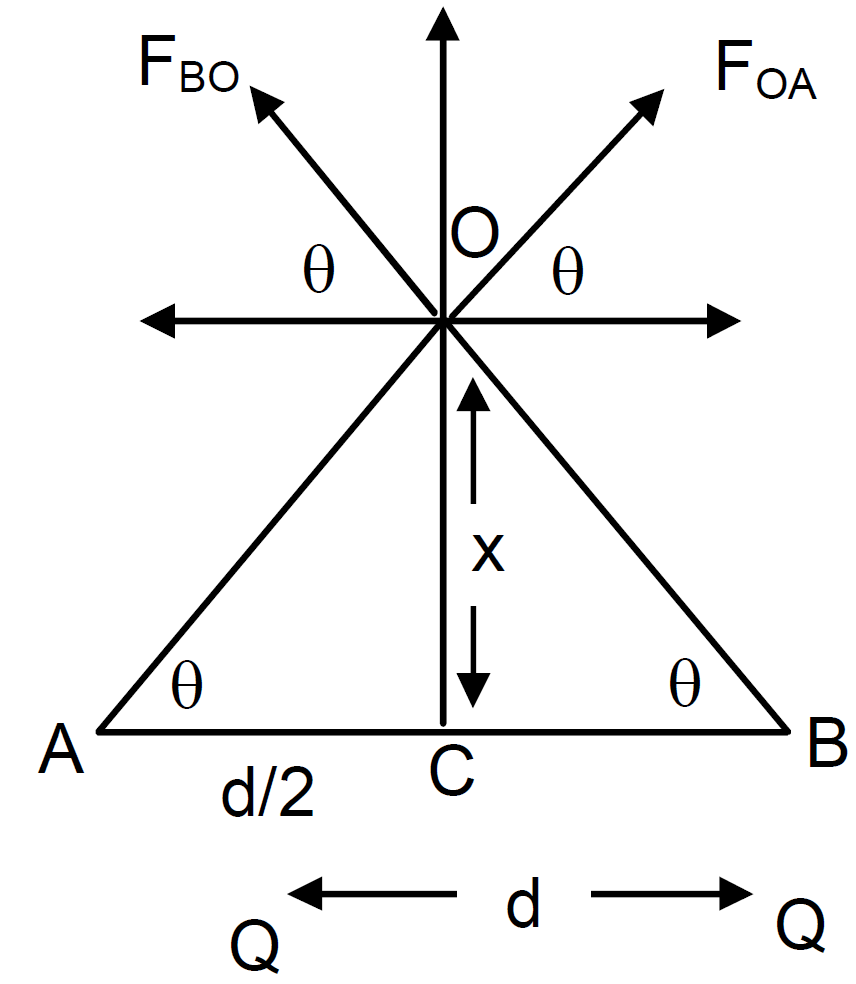
Two particles A and B, each carrying a charge Q, are held fixed with a separation d between them. A particle C having mass m and charge q is kept at the middle point of the line AB.
  1. If it is displaced through a distance x perpendicular to AB, what would be the electric force experienced by it.
  2. Assuming x << d, show that this force is proportional to x.
  3. Under what conditions will the particle C execute simple harmonic motion if it is released after such a small displacement?
Find the time period of the oscillations if these conditions are satisfied.

Answer


  1. Let Q = charge on A & B Separated by distance d

q = charge on c displaced $\bot$ to -AB

So, force on $0=\overline{\text{F}}_\text{AB}+\overline{\text{F}}_\text{BO}$

But $\text{F}_\text{AO}\cos\theta=\text{F}_\text{BO}\cos\theta$

So, force on ‘0’ in due to vertical component.

$\overline{\text{F}}=\text{F}_\text{AO}\sin\theta+\text{F}_\text{BO}\sin\theta$ $|\text{F}_\text{AO}|=|\text{F}_\text{BO}|$

$=2\frac{\text{KQq}}{\Big(\frac{\text{d}}{2^2+\text{x}^2}\big)}\sin\theta$

$\text{F}=\frac{2\text{KQq}}{\Big(\frac{\text{d}}{2}\Big)^2+\text{x}^2}\sin\theta$

$=\frac{4\times2\times2\text{KQq}}{(\text{d}^2+4\text{x}^2)}\times\frac{\text{x}}{\Big[\big(\frac{\text{d}}{2}\big)^2+\text{x}^2\Big]^{\frac{1}{2}}}$

$=\frac{2\text{kQq}}{\Big[\big(\frac{\text{d}}{2}\big)^2+\text{x}^2\Big]^{\frac{3}{2}}}\text{x}$ = Electric force $\Rightarrow\text{F}\propto\text{x}$

  1. When x << d

$\text{F}=\frac{2\text{kQq}}{\Big[\big(\frac{\text{d}}{2}\big)^2+\text{x}^2\Big]^{\frac{3}{2}}}\text{x}$ x << d

$\Rightarrow\text{F}=\frac{2\text{kQq}}{\Big(\frac{\text{d}^2}{4}\Big)^{\frac{3}{2}}}\text{x}\Rightarrow\text{F}\propto\text{x}$

$\text{a}=\frac{\text{F}}{\text{m}}=\frac{1}{\text{m}}\Bigg[\frac{2\text{kQqx}}{\Big[\big(\frac{\text{d}^2}{4}\big)+\ell^2}\Bigg]$

So time period $\text{T}=2\pi\sqrt{\frac{\ell}{\text{g}}}$

$=2\pi\sqrt{\frac{\ell}{\text{a}}}$

Need a full question paper?

Generate a complete, print-ready paper with questions like this in minutes — across 16+ boards, with answer keys.

Start Generating Free

Similar questions

Identical springs of steel and copper are equally stretched. On which, more work will have to be done?
  1. Define SHM. What are its characteristics? At what distance from the mean position in SHM of amplitude r the energy is half kinetic and half potential?
  2. A spring having a force constant K is divided into three equal parts. What would be force constant for each individual parts?
Establish an expression for excess pressure inside a liquid and drop.
or
Find the equation of pressure difference between the two surfaces of a spherical drop. What is the difference between this and soap bubbles?
or
The pressure excess inside a liquid drop is $P =$ $\frac{2 T}{r}$ and for a soap bubble the pressure excess is $P=\frac{4 T}{r}$, Prove it.
The speed of sound in hydrogen at 0°C is 1280ms-1. The density of hydrogen at STP is 0.089kg/m-3. Calculate the molar heat capacities Cp and Cv of hydrogen.
  1. It is known that density r of air decreases with height y as $\rho_0\text{e}^{-\frac{\text{y}}{\text{y}_0}}$ where $\rho=1.25\text{kg m}^{-3}$ is the density at sea level, and y0 is a constant. This density variation is called the law of atmospheres. Obtain this law assuming that the temperature of atmosphere remains a constant (isothermal conditions). Also assume that the value of g remains constant.
  2. A large He balloon of volume 1425m3 is used to lift a payload of 400kg. Assume that the balloon maintains constant radius as it rises. How high does it rise? [Take y0 = 8000m and rHe = 0.18 kgm–3].
For the travelling harmonic wave, y = 2.0 cos 2π (10t - 0.0080x + 0.35), where x and y are in cm and t in s. What is the phase difference between oscillatory motion at two points separated by a distance of,
  1. $4\text{m}$
  2. $0.5\text{m}$
  3. $\frac{\lambda}{2}$
  4. $\frac{3\lambda}{4}$
An insulated container containing monoatomic gas of molar mass m is moving with a velocity v0. If the container is suddenly stopped, find the change in temperature.
Suppose the smaller pulley of the previous problem has its radius 5.0cm and moment of inertia 0.10kg-m2. Find the tension in the part of the string joining the pulleys.
Find the components along the x, y, z axes of the angular momentum l of a particle, whose position vector is r with components x, y, z and momentum is p with components px, py and pz. Show that if the particle moves only in the x-y plane the angular momentum has only a z-component.
A container of volume 50cc contains air (mean molecular weight = 28.8g) and is open to atmosphere where the pressure is 100kPa. The container is kept in a bath containing melting ice (0°C).
  1. Find the mass of the air in the container when thermal equilibrium is reached.
  2. The container is now placed in another bath containing boiling water (100°C). Find the mass of air in the container.
  3. The container is now closed and placed in the melting-ice bath. Find the pressure of the air when thermal equilibrium is reached.