Question
The table shows four different materials and their resistivity.
MaterialResistivity(Ω m)
Material 11.62 ×10⁻⁸
Material 2100 ×10-6
Material 36.84 ×10⁻⁸
Material 444 ×10-6
1. Which material is the best conductor of electricity?
A. Material 1
B. Material 2
C. Material 3
D. Material 4
2. What is the SI unit of Resistivity?
3. Why is nichrome wire used in many electrical heating devices?
A. It has low resistivity and low melting point.
B. It has high resistivity and low melting point.
C. It has low resistivity and high melting point.
D. It has high resistivity and high melting point.
Answer

1. A. Material 1
2. Mentions ohm-meter (Ω m) as correct response. 
3. D. It has high resistivity and high melting point. 
Need a full question paper?

Generate a complete, print-ready paper with questions like this in minutes — across 16+ boards, with answer keys.

Start Generating Free

Similar questions

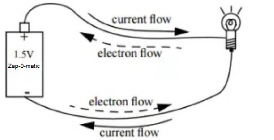
The rate of flow of charge is called electric current. The SI unit of electric current is Ampere (A). The direction of flow of current is always opposite to the direction of flow of electrons in the current.
Image
The electric potential is defined as the amount of work done in bringing a unit-positive test charge from infinity to a point in the electric field. The amount of work done in bringing a unit positive test charge from one point to another point in an electric field is defined as potential difference.
$V_{A B}=V_{B}-V_{A}=\frac{W_{B A}}{q}$
The SI unit of potential and potential difference is volt.
i. Write the formula of voltage in terms of work done, current, time and charge.
ii. What is the number of electrons flowing per second in a conductor if 1 A current is passing through it?
iii. What would be the potential difference between the two terminals of a battery, if 100 joules of work is required to transfer 20 coulombs of charge from one terminal of the battery to other?
OR
The 2 C of charge is flowing through a conductor in 100 ms , then what would be the current in the circuit?
Study the following table for a convex lens for different positions of object and answer the following questions:
Position of objectPosition of imageRelative size of image
At infinityAt focus F_(2)Highly diminished point sized
Beyond 2F_(1)Between F_(2) and 2F_(2)Diminished
At 2F_(1)At 2F_(2)Same size
Between F_(1) and 2F_(1)Beyond 2F_(2)Enlarged
At focus F_(1)At infinityInfinitely large or highly enlarged
Between focus F_(1) and optical centre OOn the same side of the lens as the objectEnlarged

(i) What is the nature of the image, if an object is placed at infinity ?
(ii) Identify the nature of the image for which the object is between focus and optical centre.
(iii) What is position of image, when object is place at focus $\left(f_1\right)$ ?
or
(iv) What is the focal length of a lens for an object placed $50 cm$ from the lens producing virtual image at a distance of $10 cm$ in front of the lens?

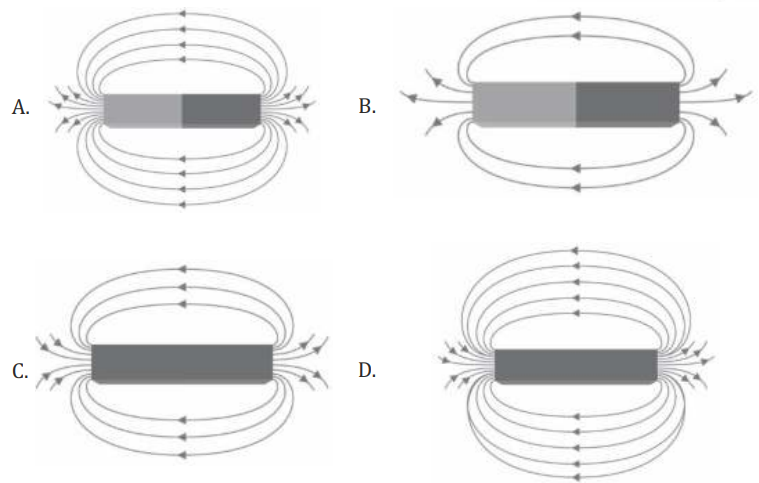
Which of these magnets has the strongest magnetic field?
Image
Read the following and answer any three questions from (i) to (iv).

The electrical energy consumed by an electrical appliance is given by the product of its power rating and the time for which it is used. The SI unit of electrical energy is Joule. Actually, Joule represents a very small quantity of energy, and therefore it is inconvenient to use where a large quantity of energy is involved. So for commercial purposes we use a bigger unit of electrical energy which is called kilowatt-hour. 1 kilowatt-hour is equal to 3.6 × 106 joules of electrical energy.

  1. The energy dissipated by the heater is E. When the time of operating the heater is doubled, the energy dissipated will?

  2. The power of a lamp is 60W. The energy consumed in 1 minute will?

  3. The electrical refrigerator rated 400W operates 8 hours a day. The cost of electrical energy is ₹ 5 per kWh. Find the cost of running the refrigerator for one day?
                                    OR
  4. Calculate the energy transformed by a 5A current flowing through a resistor of $2\Omega$ for 30 minutes?
A concave mirror forms image of an object thrice in its size on a screen. Magnification of a mirror gives information about the size of the image relative to the object. It is defined as the ratio of size of image to the size of object. It is represented by $m$.
\[
m=\frac{\text { Size of image }}{\text { Size of object }}
\]
Sign of magnification by mirror gives the information about the nature of the image produce by it.
(i) Describe the nature of image formed.
(ii) If the object $x$ distance from the pole of mirror, then find image distance from the pole.
(iii) If the radius of curvature of mirror is $R$, then write the relation between object distance, image distance and focal length of the mirror.
or
(iv) Give one use of concave mirror.
Read the following and answer any three questions from (i) to (iv).

The spreading of light by the air molecules is called scattering of light. The light having least wavelength scatters more. The sun appears red at sunrise and sunset, appearance of blue sky it is due to the scattering of light. The colour of the scattered light depends on the size of particles. The smaller the molecules in the atmosphere scatter smaller wavelengths of tight. The amount of scattering of light depends on the wavelength of light. When light from sun enters the earth's atmosphere, it gets scattered by the dust particles and air molecules present in the atmosphere. The path of sunlight entering in the dark room through a fine hole is seen because of scattering of the sun light by the dust particles present in its path inside the room.

  1. To an astronaut in a spaceship, What colour of the earth appears?

  2. The colour of sky appears blue, it is due to?
  3. Define scattering of light? also write an example
                               OR.
  4. The danger signs made red in colour, why?
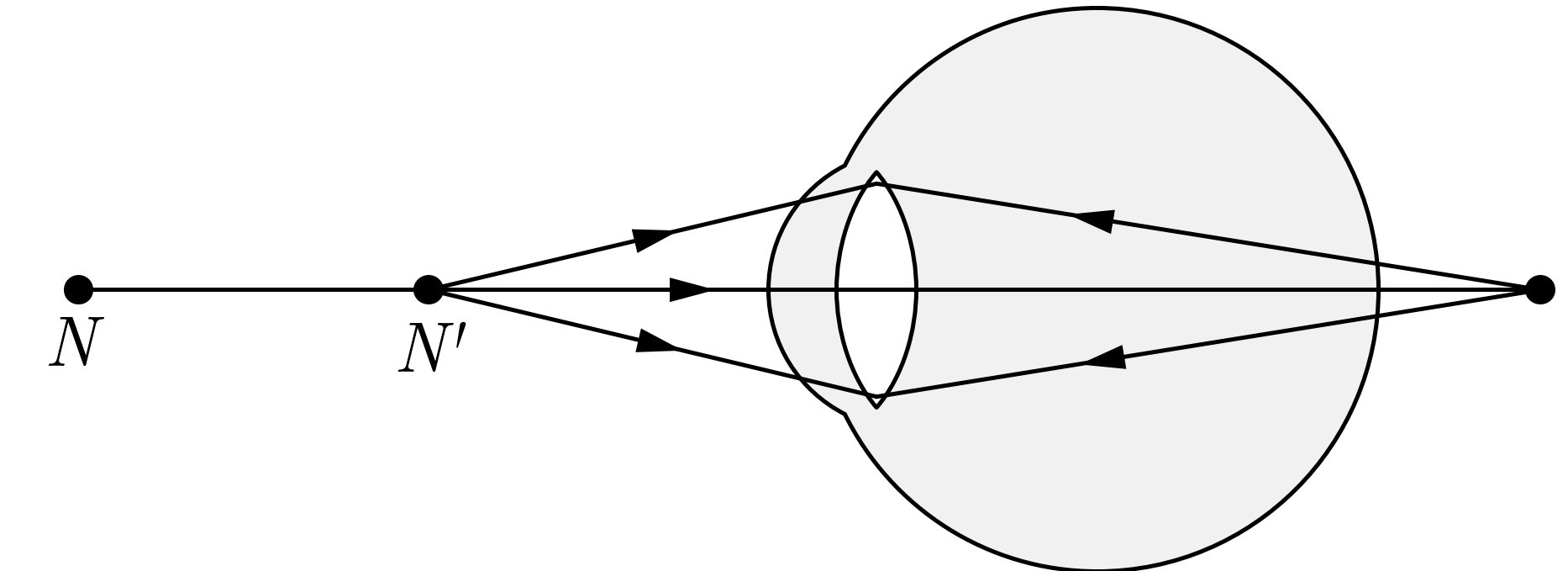
A person is suffering from hypermetropia (long sightedness). It is a defect in which a human eye can see far off object clearly, but is unable to see nearby object distinctly. The near point of the person is $1.5 m$. Assume that the near point of the normal eye is $25 cm$.

(i) What type of lens should be used in his spectacles?
(ii) What should be the focal length of the lens he used?
(iii) What will be the potver of the lens?
or
(iv) Write one possible cause of this defect.
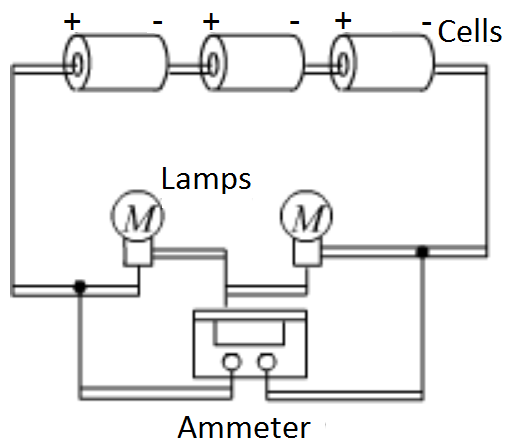
A student made an electric circuit shown here to measure the current through two lamps.
  1. Are the lamps in series or parallel?
  2. The student has made a mistake in this circuit. What is the mistake?
  3. Draw a circuit diagram to show the correct way to connect the circuit. Use the proper circuit symbols in your diagram.