Question
The teacher while conducting practicals in the laboratory divided the students into three groups and gave them various solutions to find out their pH and classify them into acidic, basic and neutral solutions.
Group A - Lemon juice, vinegar, colourless aerated drink
Group B - Tomato juice, coffee, ginger juice
Group C - Sodium hydroxide, sodium chloride, lime water
(a) For the solutions provided, which group is/are likely to have pH value (i) less than 7, and (ii) greater than 7?
(b) List two ways of determining pH of a solution.
OR
Explain, why the sour substances such as lemon juice are effective in cleaning the tarnished copper vessels.
Answer

The teacher while conducting practicals in the laboratory divided the students into three groups and gave them various solutions to find out their pH and classify them into acidic, basic and neutral solutions.
Group A - Lemon juice, vinegar, colourless aerated drink
Group B - Tomato juice, coffee, ginger juice
Group C - Sodium hydroxide, sodium chloride, lime water
(i) i. Groups A and B - less than 7
ii. Group C - greater than 7
(ii) pH paper and universal indicator.
OR
i. Copper vessel is tarnished due to formation of basic copper oxide.
ii. Lemon juice being acidic react with copper oxide and the salt formed is washed away.

Need a full question paper?

Generate a complete, print-ready paper with questions like this in minutes — across 16+ boards, with answer keys.

Start Generating Free

Similar questions

Read the following and answer any three questions from: (i) to (iv).An ecosystem may be defined as a structural and functional unit of the biosphere comprising living organisms and their non-living environment which interact by means of food chains and biogeochemical cycles resulting in energy-flow, biotic diversity and material cycling to form a stable, self-supporting system.
  1. The two basic processes involved in an ecosystem are?
     
  2. Give two examples of not an artificial ecosystem?
     
  3. What is the role of fungi and bacteria in an ecosystem?
     
  4. What would one of the likely result if all decomposers in a particular ecosystem were wiped out?
Read the following and answer any three questions from (i) to (iv).The table given below shows six organic compounds A, B, C, D, E and F having different molecular formula:
Organic compound
Molecular formula
A
$C _7 H _{16}$
B
$C _8 H _{16}$  
C
$C _4 H _6$  
D
$C _6 H _{10}$  
E
$C _5 H _{10}$  
F
$C _9 H _{20}$
  1. Write compounds belonging to the same homologous series?
     
  2. Write the member of the same homologous series as E with the help of the table?
     
  3. Identify Compound B from a given table.

    OR
     
  4. A) Write the general formula of Compound (F).
    B) Explain Different between organic and molecular compounds.
Study the following table for a convex lens for different positions of object and answer the following questions:
Position of objectPosition of imageRelative size of image
At infinityAt focus F_(2)Highly diminished point sized
Beyond 2F_(1)Between F_(2) and 2F_(2)Diminished
At 2F_(1)At 2F_(2)Same size
Between F_(1) and 2F_(1)Beyond 2F_(2)Enlarged
At focus F_(1)At infinityInfinitely large or highly enlarged
Between focus F_(1) and optical centre OOn the same side of the lens as the objectEnlarged

(i) What is the nature of the image, if an object is placed at infinity ?
(ii) Identify the nature of the image for which the object is between focus and optical centre.
(iii) What is position of image, when object is place at focus $\left(f_1\right)$ ?
or
(iv) What is the focal length of a lens for an object placed $50 cm$ from the lens producing virtual image at a distance of $10 cm$ in front of the lens?

Study the table related to colour change with indicators and answer the questions that follow.
SolutionsColour change with phenolphthalein indicatorColour change with methyl orange indicator
PPinkYellow
QColourlessOrange
RColourlessRed

(i) Name the solution which is acidic.
(ii) Arrange the given solutions in increasing order of their $pH$ value.
(iii) What is the name of solution $P$ and $Q$ ?
or
(iv) When solution $P$ added to the china rose indicator, what is the colour of solution $P$ ?


Read the following and answer any three questions from (i) to (iv).
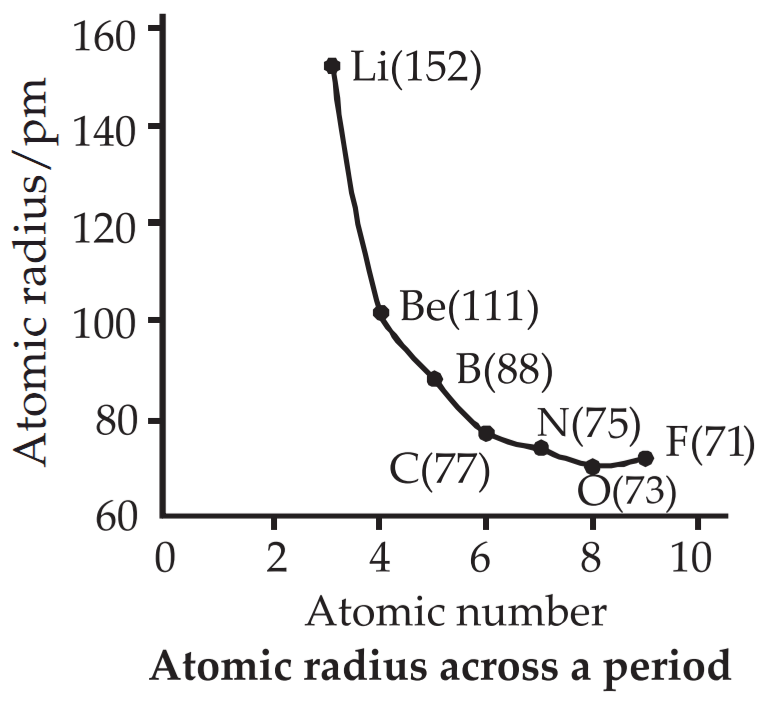
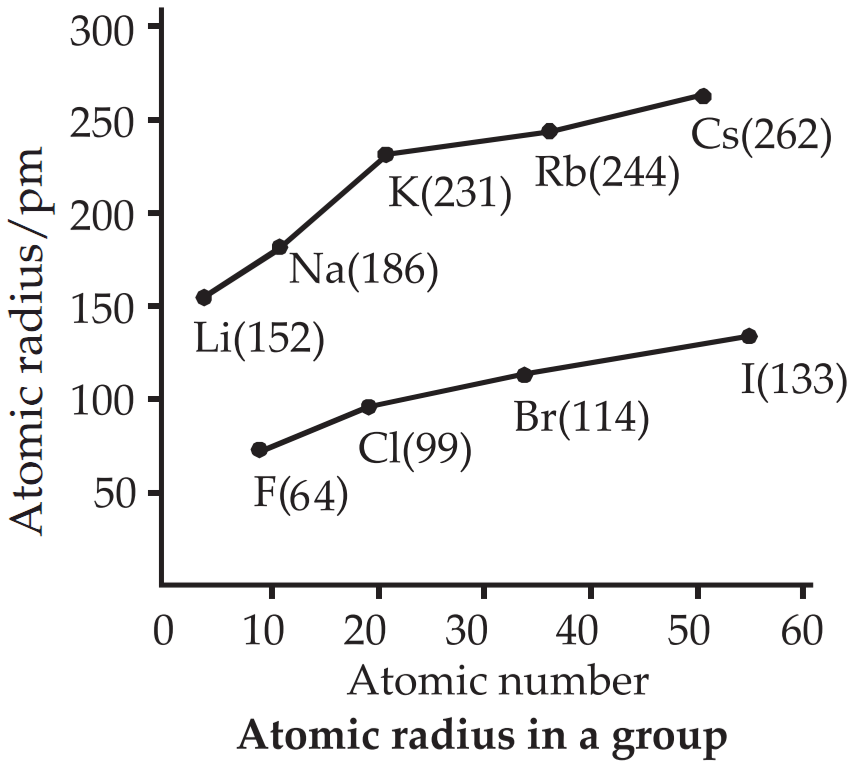
The distance between the centre of the nucleus and the outermost shell of electrons is known as atomic radius. On moving from left to right along a period, atomic radii decrease because effective nuclear charge increases. For example, the atomic size decreases regularly from Li to F in the second period and from Na to Cl in the third period. It may, however, be noted that in any period, the noble gas has the largest size. On moving down in a group, atomic radii increase.

  1. Write the maximum atomic radius?
     
  2. Which element is the smallest size in group 13?
     
  3. why the atomic radius decreases as we move across a period?

    OR
  4. A) ln the third period of the periodic table, Which element has the smallest size?
    b) define atomic radius?
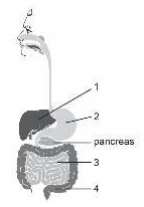
The diagram below shows the human alimentary canal.
1, 2, 3 and 4 are four different organs that are parts of the canal.

Image
8. Which of the labelled parts represents the liver?
A. 1
B. 2
C. 3
D. 4
9. Which of the following will be adversely affected in Mr. Ayub’s body?
Pancreas secretes lipase enzyme. Mr. Ayub is suffering from malfunctioning of the pancreas.
A. Digestion of carbohydrates
B. Digestion of proteins
C. Digestion of fats
D. Digestion of vitamins

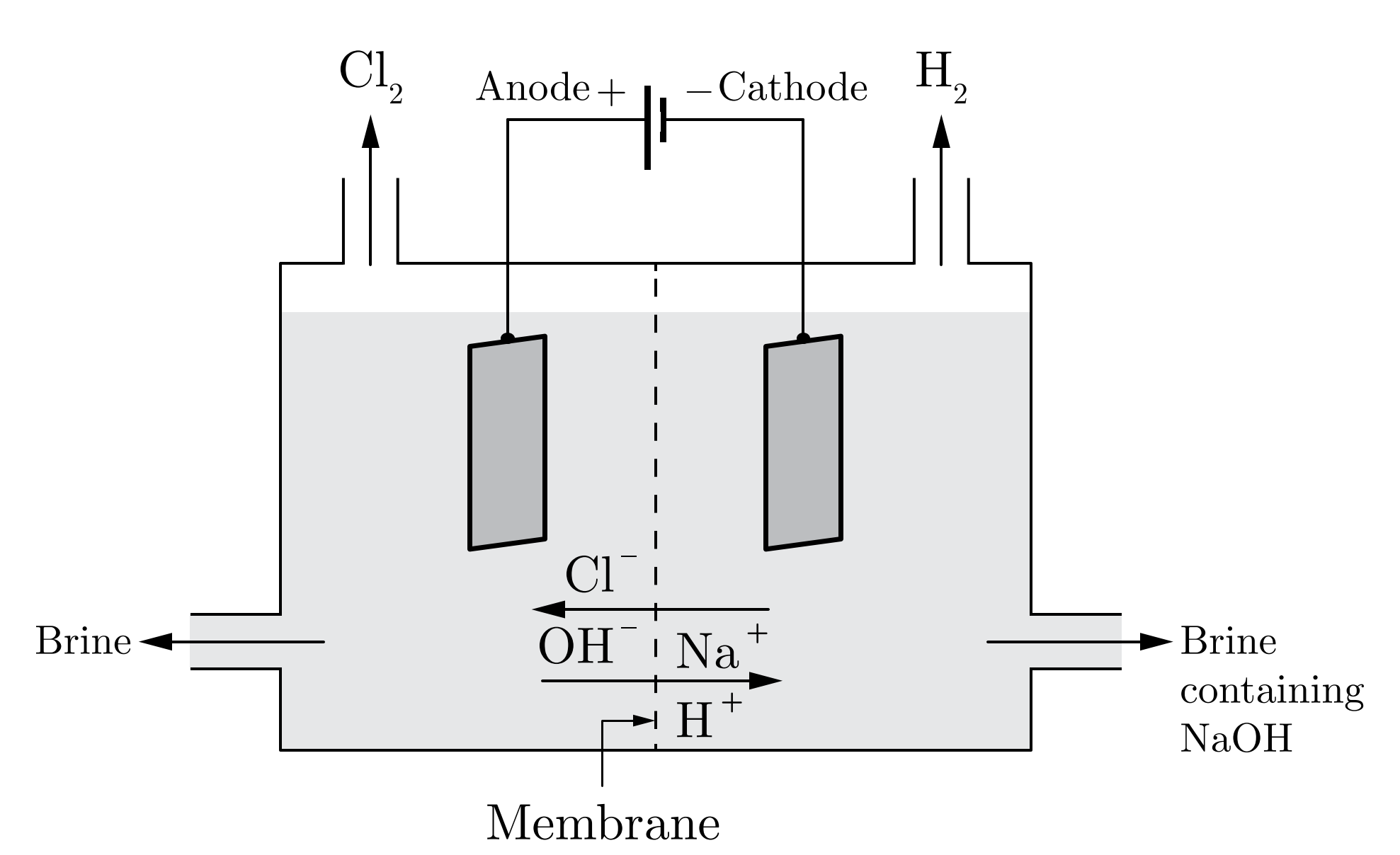
Refining is the process of purification of metals. One of the important method of refining is electrolysis. In electrolysis, electrical energy is used to bring about a non-spontaneous redox reaction. This is done by passing an electric current through a liquid containing ions, known as an electrolyte. In contrast to metals, the current in electrolytes is carried by the movement of ions rather than the movement of electrons. The solid conductors inserted into the liquid are called electrodes, the one with a positive charge is called the anode (because it attracts anions) and the one with the negative charge is called the cathode.
A diagrammatic representation of electrolysis of copper is shown below :


(i) Name the electrolyte used in refining of copper.
(ii) a. $Cu \longrightarrow Cu ^{2+}+2 e ^{-}$
b. $Cu ^{2+}+2 e ^{-} \longrightarrow Cu$
Which of these two reactions occur at cathode and anode?
or
(iii) What is anode mud? Name two metals which can be refined by electrolytic method.

Read the following and answer any four questions from (i) to (v).
The green plants make their food, through photosynthesis and are therefore called autotrophs. All other organisms depend upon green plants for food and are referred to as heterotrophs. Green plants carry out photosynthesis by using light energy of sun. The first phase of reactions are directly light driven therefore called light reactions. The second phase of reactions are not directly light driven but are dependent on the products of light reactions and are called dark reactions.
  1. Which of the following is produced during the light phase of photosynthesis?
  1. ATP
  2. NADPH
  3. Carbohydrate
  4. Both (a) and (b)
  1. ln the overall process of photosynthesis, the number of sugar molecules produced is:
  1. 12
  2. 6
  3. 4
  4. 1
  1. A plant is provided with ideal conditions for photosynthesis and supplied with isotope ${ }^{14} CO _2$ When the products of the process are analysed carefully, what would be the nature of products?
  1. Both glucose and oxygen are normal.
  2. Both glucose and oxygen are labelled.
  3. Only glucose is labelled and oxygen is normal.
  4. Only oxygen is labelled and glucose is normal.
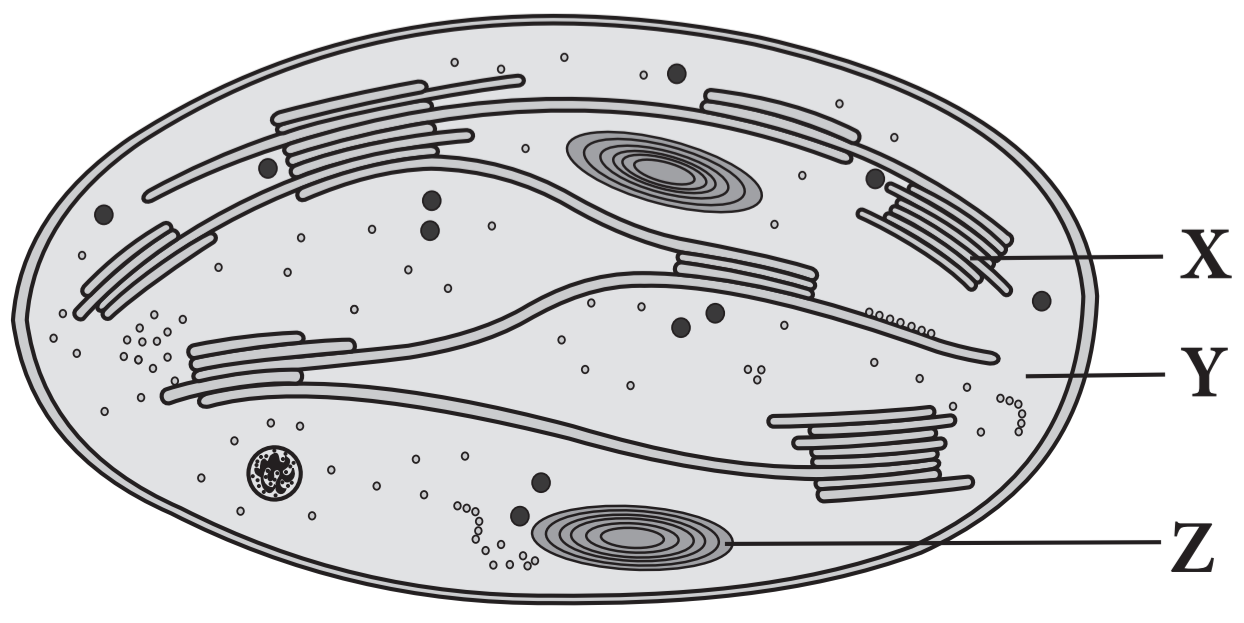
  1. Refer to the given diagrammatic representation of an electron micrograph of a section of chloroplast and answer the question.


Select the option which correctly depicts the functions of parts X, Y and Z.
 
X
Y
Z
(a)
Dark reaction
Light reaction
Carbohydrate synthesis
(b)
Light reaction
Carbohydrate synthesis
Carbohydrate storage
(c)
Light reaction
Carbohydrate storage
Carbohydrate synthesis
(d)
Carbohydrate synthesis
Carbohydrate storage
Cytoplasmic inheritance
  1. Following table summarises the differences between light and dark reactions.
 
Light reactions
Dark reactions
(I)
These are also called biosynthetic phase.
These are also called photochemical phase.
(II)
These reactions occur over thylakoids
These reactions occur in stroma of chloroplasts.
(III)
These produce assimilatory power i.e., NADPH and ATP.
These consume NADPH and ATP.
(IV)
These are directly dependent upon light.
'They depend upon the products synthesised during light reactions.
Which of the following is correct group of differences?
  1. (I), (II) and (III)
  2. (II), (III) and (IV)
  3. (II) and (III)
  4. (I) and (IV)
A near sighted person wears eye glass with power of $-5.0$ D for distant vision. Soon, he started having difficulties in viewing nearby objects also. His doctor prescribes a correction of $+1.5 D$ in near vision section of his bi-focal, which is measured relative to main part of the lens.

(i) Find the focal length of his distant viewing part of lens.
(ii) Find the focal length of near vision section of the lens.
(iii) What type of lens is to be used in this spectacles for near vision?
or
(iv) What is the reason of hypermetropia?