MCQ
The temperature at which the root mean square velocity of a molecule will be doubled than at $100°C$
  • $1219°C$
  • B
    $1492°C$
  • C
    $400°C$
  • D
    $400\, K$

Answer

Correct option: A.
$1219°C$
a
$R.M.S.$ velocity $\sqrt{\frac{3 R T}{M}}$

How, when other terms are constant, $(R \cdot M . S) \propto \sqrt{T}$.

$\frac{(R \cdot M \cdot S)_{1}}{(R \cdot M \cdot S)_{2}}=\frac{\sqrt{T_{1}}}{\sqrt{T_{2}}}$

Here, $(R \cdot M \cdot S)_{2}=2 \cdot(R \cdot M \cdot S)_{1}$

$T_{1} =100^{\circ} C =(100+273) K =373 \; K$

$\therefore \frac{(R \cdot M \cdot S)_{1}}{2 \cdot(R \cdot M \cdot S)} =\frac{\sqrt{373}}{\sqrt{T_{2}}}$

$\sqrt{T_{2}} =2 \cdot \sqrt{373}$

$T_{2} =1492 \; K$ [squaring both sides]

Convert into celcius.,

$T_{2}=(1492-273)^{\circ} C =1219^{\circ} C$

Need a full question paper?

Generate a complete, print-ready paper with questions like this in minutes — across 16+ boards, with answer keys.
Start Generating Free

Similar questions

The internal energy of an ideal gas depends on:
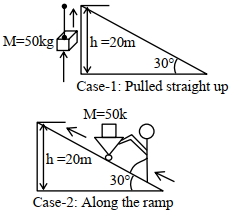
A body of mass $50 \mathrm{~kg}$ is lifted to a height of $20 \mathrm{~m}$ from the ground in the two different ways as shown in the figures. The ratio of work done against the gravity in both the respective cases, will be:
Pascal is the unit of:
One mole of an ideal monoatomic gas undergoes the following four reversible processes:

Step $1$ It is first compressed adiabatically from volume $8.0 \,m ^{3}$ to $1.0 \,m ^{3}$.

Step $2$ Then expanded isothermally at temperature $T_{1}$ to volume $10.0 \,m ^{3}$.

Step $3$ Then expanded adiabatically to volume $80.0 \,m ^{3}$.

Step $4$ Then compressed isothermally at temperature $T_{2}$ to volume $8.0 \,m ^{3}$.

Then, $T_{1} / T_{2}$ is
Equation of plane wave is $y=4 \sin \frac{\pi}{4}\left[2 t+\frac{x}{8}\right]$
The phase difference at any given instant of two particles 16 cm apart is
A man is standing at the centre of frictionless pond of ice. How can he get himself to the shore
A block moving horizontally on a smooth surface with a speed of $40\, {ms}^{-1}$ splits into two equal parts. If one of the parts moves at $60\, {ms}^{-1}$ in the same direction, then the fractional change in the kinetic energy will be $x: 4$ where $x=..... .$
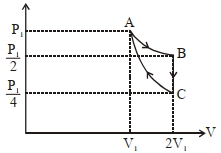
If one mole of an ideal gas at $\left( P _{1}, V _{1}\right)$ is allowed to expand reversibly and isothermally ($A$ to $B$ ) its pressure is reduced to one-half of the original pressure (see $figure$). This is followed by a constant volume cooling till its pressure is reduced to one-fourth of the initial value $( B \rightarrow C ) .$ Then it is restored to its initial state by a reversible adiabatic compression ($C$ to $A$). The net workdone by the gas is equal to  ...... .
In a typical combustion engine the work done by a gas molecule is given $W =\alpha^{2} \beta e ^{\frac{-\beta x ^{2}}{ KT }}$, where $x$ is the displacement, $k$ is the Boltzmann constant and $T$ is the temperature. If $\alpha$ and $\beta$ are constants, dimensions of $\alpha$ will be
Equal mass of three liquids are kept in three identical cylindrical vessels $A, B$ and $C$. The densities are $P_A, P_B, P_C$ with $P_A$