Question
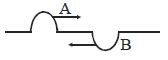
Two identical harmonic pulses travelling in opposite directions in a taut string approach each other. At the instant when they completely overlap, the total energy of the string will be
Answer

When they overlap, they form stationary waves, as they cancel each other because of the opposite direction and equal magnitude.

Hence the displacement of the string becomes zero, resulting in zero potential energy and purely kinetic energy.

Need a full question paper?

Generate a complete, print-ready paper with questions like this in minutes — across 16+ boards, with answer keys.

Start Generating Free

Similar questions

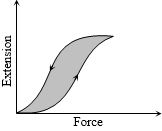
The diagram shows a force-extension graph for a rubber band. Consider the following statements

$I.$ It will be easier to compress this rubber than expand it

$II.$ Rubber does not return to its original length after it is stretched

$III.$ The rubber band will get heated if it is stretched and released

Which of these can be deduced from the graph
A series combination of resistor of resistance $100\,\Omega$, inductor of inductance $1\,H$ and capacitor of capacitance $6.25\,\mu F$ is connected to an ac source. The quality factor of the circuit will be $.............$.
If $10000\, V$ is applied across an $X$ - ray tube, what will be the ratio of de-Broglie wavelength of the incident electrons to the shortest wavelength of $X$ - ray produced ($\frac{e}{m}$ for electron is $1.8 \times {10^{11}}\,c\,k{g^{ - 1}}$)
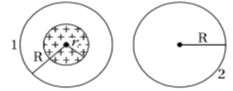
A uniform magnetic field is restricted within a region of radius $r.$ The magnetic field changes with time at a rate $\frac{{d\vec B}}{{dt}}$. Loop $1$ of radius $R > r$ encloses the region rand loop $2$ of radius $R$ is outside the region of magnetic field as shown in the figure. Then the $e.m.f.$ generated is 
A $5$ watt source emits monochromatic light of wavelength $5000\; \mathring A$. When placed $0.5\; m$ away, it liberates photoelectrons from a photosensitive metallic surface. When the source is moved to a distance of $1.0\;m$, the number of photo electrons liberated will
In the arrangement shown, the mass $m$ will ascend with an acceleration (Pulley and rope are massless)
A satellite of earth of mass $'m'$ taken from orbital radius $2R$ to $3R,$ then minimum work done
The magnifying power of a telescope with tube $60\; \mathrm{cm}$ is $5 .$ What is the focal length of its eye piece?......$cm$
A string is wrapped around the rim of a wheel of moment of inertia $0.40 \mathrm{kgm}^2$ and radius $10 \mathrm{~cm}$. The wheel is free to rotate about its axis. Initially the wheel is at rest. The string is now pulled by a force of $40 \mathrm{~N}$. The angular velocity of the wheel after $10$ $\mathrm{s}$ is $\mathrm{x} \mathrm{rad} / \mathrm{s}$, where $\mathrm{x}$ is $\qquad$
A solid sphere of radius $R$ made of of material of bulk modulus $K$ is surrounded by a liquid in a cylindrical container. $A$ massless piston of area $A$ floats on the surface of the liquid. When a mass $m$ is placed on the piston to compress the liquid, the fractional change in the radius of the sphere $\delta R/R$ is