MCQ
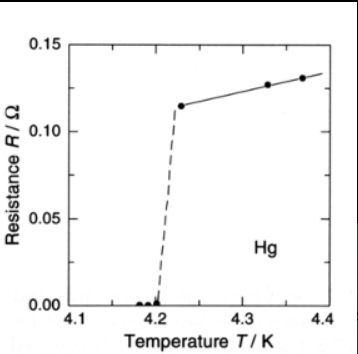
The temperature bellow which a material becomes a superconductor is called:
- ACritical temperature.
- BAbsolute temperature.
- CTripple point.
- DNone of the above.
Explanation:
Critical temperature is the temperature below which metals when taken exhibit zero resistivity and turns into a superconductor. The critical temperature varies with the individual material. Because these materials have no electrical resistance, meaning electrons can travel freely through them, they can carry large amounts of electrical current for long periods of time without losing energy as heat. The transition is so sudden and complete that it appears to be a transition to a different phase of matter; known as the superconducting phase.
Generate a complete, print-ready paper with questions like this in minutes — across 16+ boards, with answer keys.
A coil having an inductance of 0.5 H carries a current which is uniformly varying from zero to 10 ampere in 2 second. The e.m.f. (in volts) generated in the coil is
|
(a) 10 |
(b) 5 |
(c) 2.5 |
(d) 1.25 |
In the shown arrangement of the experiment of the meter bridge if AC corresponding to null deflection of galvanometer is x, what would be its value if the radius of the wire AB is doubled

|
(a) x |
(b) x/4 |
(c) 4x |
(d) 2x |
Energy stored in electromagnetic oscillations is in the form of
|
(a) Electrical energy |
(b) Magnetic energy |
(c) Both (a) and (b) |
(d) None of these |
The work function of metal is 1 eV. Light of wavelength 3000 Å is incident on this metal surface. The velocity of emitted photo-electrons will be
|
(a) 10 m/sec |
(b) 1 |
(c) |
(d) |
$\text{A}\omega^2$
$\frac{\text{A}\omega^2}{2}$
$\frac{\text{A}\omega^2}{\sqrt{2}}$
$\text{Zero}.$


