The temperature of a body falls from $62^oC\, to\, 50^oC$ in $10$ minutes. If the temperature of the surroundings is $26^oC$, the temperature in next $10$ minutes will become ...... $^oC$
Medium


Download our appand get started for free
Experience the future of education. Simply download our apps or reach out to us for more information. Let's shape the future of learning together!No signup needed.*
Similar Questions
- 1The radiant energy from the sun incident normally at the surface of earth is $20\, \frac{{k\;cal}}{{{m^2}\;min}}$. What would have been the radiant energy incident normally on the earth, if the sun had a temperature twice of the present one ....... $kcal/m ^2 \,min$View Solution
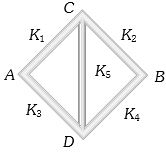
- 2Five rods of same dimensions are arranged as shown in the figure. They have thermal conductivities $K1, K2, K3, K4$ and $K5$ . When points $A$ and $B$ are maintained at different temperatures, no heat flows through the central rod ifView Solution
- 3Solar radiation emitted by sun resembles that emitted by a black body at a temperature of $6000 K$ . Maximum intensity is emitted at a wavelength of about $4800Å$ . If the sun were to cool down from $6000 K$ to $3000 K$ then the peak intensity would occur at a wavelength ....... $\overset{o}{\mathop{A}}\,$View Solution
- 4View SolutionIce is used in a cooler in order to cool its contents. Which of the following will speed up the cooling process?
- 5The wavelength of maximum emitted energy of a body at $700 K$ is $4.08$ $\mu m$. If the temperature of the body is raised to $1400 K$ , the wavelength of maximum emitted energy will be ........ $\mu m$View Solution
- 6A small object is placed at the center of a large evacuated hollow spherical container. Assume that the container is maintained at $0 K$. At time $t =0$, the temperature of the object is $200 K$. The temperature of the object becomes $100 K$ at $t = t _1$ and $50 K$ at $t = t _2$. Assume the object and the container to be ideal black bodies. The heat capacity of the object does not depend on temperature. The ratio $\left( t _2 / t _1\right)$ is. . . . .View Solution
- 7The temperatures of two bodies $A$ and $B$ are ${727^o}C$ and ${127^o}C$. The ratio of rate of emission of radiations will beView Solution
- 8A heated body maintained at $T\,K$ emits thermal radiation of total energy $E$ with a maximum intensity at frequency $v$ . The emissivity of the material is $0.5$ . If the temperature of the body be increased and maintained at temperature $3T\,K$ , thenView Solution
$(i)$ The maximum intensity of the emitted radiation will occur at frequency $v /3$
$(ii)$ The maximum intensity of the emitted radiation will occur at frequency $3v $
$(iii)$ The total energy of emitted radiation will become $81\,E$
$(iv)$ The total energy of emitted radiation will become $27\,E$
- 9View SolutionNewton's law of cooling is used in laboratory for the determination of the
- 10View SolutionAt a common temperature, a block of wood and a block of metal feel equally cold or hot. The temperatures of block of wood and block of metal are