The wavelength of maximum emitted energy of a body at $700 K$ is $4.08$ $\mu m$. If the temperature of the body is raised to $1400 K$ , the wavelength of maximum emitted energy will be ........ $\mu m$
Easy
Download our app for free and get started
(d) ${\lambda _{{m_1}}}{T_1} = {\lambda _{{m_2}}}{T_2} \Rightarrow {\lambda _{{m_2}}} = \frac{{{\lambda _{{m_{_1}}}}{T_1}}}{{{T_2}}}$$ = 4.08 \times \frac{{700}}{{1400}} = 2.04\,\mu m$

Download our appand get started for free
Experience the future of education. Simply download our apps or reach out to us for more information. Let's shape the future of learning together!No signup needed.*
Similar Questions
- 1The end $A$ of a rod $AB$ of length $1\,m$ is maintained at $80\,^oC$ and the end $B$ at $0\,^oC.$ The temperature at a distance of $60\,\,c.m.$ from the end $A$ is......... $^oC$View Solution
- 2The temperature of a piece of iron is ${27^o}C$ and it is radiating energy at the rate of $Q\;kW{m^{ - 2}}$. If its temperature is raised to ${151^o}C$, the rate of radiation of energy will become approximately ....... $Q\,kW\,{m^{ - 2}}$View Solution
- 3View SolutionOn a cold morning, a metal surface will feel colder to touch than a wooden surface because
- 4In a room where the temperature is ${30^o}C$, a body cools from ${61^o}C$ to ${59^o}C$ in $4$ minutes. The time (in min.) taken by the body to cool from ${51^0}C$ to ${49^0}C$ will be ....... $\min$View Solution
- 5The intensity of radiation emitted by the sun has its maximum value at a wavelength of $510\;nm$ and that emitted by the north star has the maximum value at $350\;nm$. If these stars behave like black bodies, then the ratio of the surface temperature of the sun and north star isView Solution
- 6View SolutionThe wavelength of radiation emitted by a body depends upon
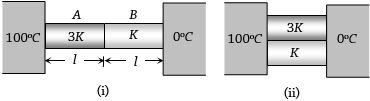
- 7Two conducting rods $A$ and $B$ of same length and cross-sectional area are connected $(i)$ In series $(ii)$ In parallel as shown. In both combination a temperature difference of $100^o C$ is maintained. If thermal conductivity of $A$ is $3K$ and that of $B$ is $K$ then the ratio of heat current flowing in parallel combination to that flowing in series combination isView Solution
- 8View SolutionIn which of the following process, convection does not take place primarily
- 9The area of the hole of heat furnace is $10^{-4}\,m^2.$ It radiates $1.58\times 10^5\,cal$ of heat per hour. If the emissivity of the furnace is $0.80,$ then its temperature is .......... $K$View Solution
- 10Three large identical plates are kept parallel to each other. The outer two plates are maintained at temperatures $T$ and $2 T$, respectively. The temperature of the middle plate in steady state will be close to ........... $T$View Solution