The terminal velocity $\left( v _{ t }\right)$ of the spherical rain drop depends on the radius ( $r$ ) of the spherical rain drop as
JEE MAIN 2022, Easy
Download our app for free and get started
$v _{ t }=\frac{2}{9} \frac{ gr ^{2}\left(\rho_{ p }-\rho_{1}\right)}{\eta} ; \quad v _{ t } \propto r ^{2}$

Download our appand get started for free
Experience the future of education. Simply download our apps or reach out to us for more information. Let's shape the future of learning together!No signup needed.*
Similar Questions
- 1A solid sphere of radius $R$ and density $\rho$ is attached to one end of a mass-less spring of force constant $k$. The other end of the spring is connected to another solid sphere of radius $R$ and density $3 p$. The complete arrangement is placed in a liquid of density $2 p$ and is allowed to reach equilibrium. The correct statement$(s)$ is (are)View Solution
$(A)$ the net elongation of the spring is $\frac{4 \pi R^3 \rho g}{3 k}$
$(B)$ the net elongation of the spring is $\frac{8 \pi R^3 \rho g}{3 k}$
$(C)$ the light sphere is partially submerged.
$(D)$ the light sphere is completely submerged.
- 2A train with cross-sectional area $S _{ t }$ is moving with speed $v_t$ inside a long tunnel of cross-sectional area $S _0\left( S _0=4 S _{ t }\right)$. Assume that almost all the air (density $\rho$ ) in front of the train flows back between its sides and the walls of the tunnel. Also, the air flow with respect to the train is steady and laminar. Take the ambient pressure and that inside the train to be $p _0$. If the pressure in the region between the sides of the train and the tunnel walls is $p$, then $p _0- p =\frac{7}{2 N } \rho v_{ t }^2$. The value of $N$ is. . . . .View Solution
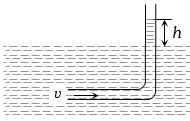
- 3An $ L-$ shaped glass tube is just immersed in flowing water such that its opening is pointing against flowing water. If the speed of water current is $v$, thenView Solution
- 4A $U-$tube contains water and methylated spirit separated by mercury. The mercury columns in the two arms are in level with $10.0\; cm$ of water in one arm and $12.5\; cm $ of spirit in the other. if $15.0\; cm$ of water and spirit each are further poured into the respective arms of the tube, what is the difference in the levels (in $cm$) of mercury in the two arms?View Solution
(the specific gravity of spirit is $0.8.)$
- 5View SolutionConstruction of submarines is based on
- 6An air bubble of radius $r$ rises steadily through a liquid of density $\rho $ with velocity $v$ . The coefficient of viscosity of liquid isView Solution
- 7An inverted tube barometer is kept on a lift with a moving downward with a deceleration $\alpha $ . The density of mercury is $\rho$ and acceleration due to gravity is $g$ . If the atmospheric pressure be $P_0$ thenView Solution
- 8A cubical block of wood of specific gravity $0.5$ and a chunk of concrete of specific gravity $2.5$ are fastened together. The ratio of the mass of wood to the mass of concrete which makes the combination to float with its entire volume submerged under water isView Solution
- 9A block of wood floats in water with $\frac{4}{5}^{th}$ of its volume submerged, but it just floats in another liquid. The density of liquid is $($in $kg / m ^3 )$View Solution
- 10There is a $1$ $mm $ thick layer of glycerine between a flat plate of area $100$ $cm^2$ $\&$ a big fixed plate. If the coefficient of viscosity of glycerine is $1.0$ $kg/m^{-s}$ then ....... $N$ force is required to move the plate with a velocity of $7$ $cm/s$ ?View Solution