MCQ
The three basic properties possessed by the electric charge are:
- AQuantisation.
- BAdditivity.
- CConservation.
- DAll.
Generate a complete, print-ready paper with questions like this in minutes — across 16+ boards, with answer keys.
Match the List I with the List II from the combination shown. In the left side (List I) there are four different conditions and in the right side (List II), there are ratios of heat produced in each resistance for each condition :
|
List I |
List II |
||
|
(I) |
Two wires of same resistance are connected in series and same current is passed through them |
(A) |
1 : 2 |
|
(II) |
Two wires of resistance R and 2R ohm are connected in series and same P.D. is applied across them |
(B) |
4 : 1 |
|
(III) |
Two wires of same resistance are connected in parallel and same current is flowing through them |
(C) |
1 : 1 |
|
(IV) |
Two wires of resistances in the ratio 1 : 2 are connected in parallel and same P.D. is applied across them |
(D) |
2 : 1 |
|
(a) I – B; II – A; III – C; IV - D |
(b) I – C; II – D; III – C; IV - D |
|
(c) I – B; II – D; III – A; IV - C |
(d) I – A; II – B; III – D; IV - C |
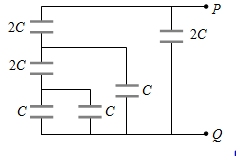
The resultant capacitance of given circuit is
|
(a) 3C |
(b) 2C |
(c) C |
(d) |
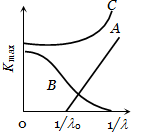
The correct graph between the maximum energy of a photoelectron and the inverse of wavelength of the incident radiation is given by the curve
|
(a) A |
(b) B |
(c) C |
(d) None of the above |
The figure shows a double slit experiment P and Q are the slits. The path lengths PX and QX are nλ and (n+2)λ respectively, where n is a whole number and λ is the wavelength. Taking the central fringe as zero, what is formed at X

|
(a) First brigh |
(b) First dark |
(c) Second bright |
(d) Second dark |
Point charges +4q, -q and +4q are kept on the x - axis at points x = 0, x = a and x = 2a respectively, then
|
(a) Only q is in stable equilibrium |
(b) None of the charges are in equilibrium |
|
(c) All the charges are in unstable equilibrium |
(d) All the charges are in stable equilibrium |
