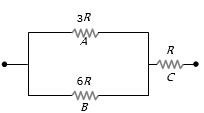
The three resistances $A, B$ and $C$ have values $3R, 6R$ and $R$ respectively. When some potential difference is applied across the network, the thermal powers dissipated by $A, B$ and $C$ are in the ratio
Medium
Download our app for free and get started
(c)Thermal power in $A = {P_A} = {\left( {\frac{{2i}}{3}} \right)^2}3R = \frac{4}{3}{i^2}R$
Thermal power in $B = {P_B} = {\left( {\frac{i}{3}} \right)^2}6R = \frac{2}{3}{i^2}R$
Thermal power in $C = {P_C} = {i^2}R$
$ \Rightarrow {P_A}:{P_B}:{P_C}$
$ = \frac{4}{3}:\frac{2}{3}:1 = 4:2:3$
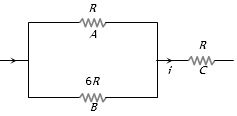
Thermal power in $B = {P_B} = {\left( {\frac{i}{3}} \right)^2}6R = \frac{2}{3}{i^2}R$
Thermal power in $C = {P_C} = {i^2}R$
$ \Rightarrow {P_A}:{P_B}:{P_C}$
$ = \frac{4}{3}:\frac{2}{3}:1 = 4:2:3$

Download our appand get started for free
Experience the future of education. Simply download our apps or reach out to us for more information. Let's shape the future of learning together!No signup needed.*
Similar Questions
- 1An electric kettle takes $4\, A$ current at $220\, V$. How much time will it take to boil $1\, kg$ of water from room temperature $20\,^\circ C$ ? The temperature of boiling water is $100\,^\circ C$ .................. $minutes$View Solution
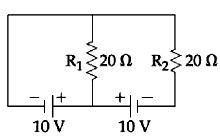
- 2In the given circuit the cells have zero internal resistance. The currents (in Amperes) passing through resistance $R_1$ and $R_2$ respectively, areView Solution
- 3A flow of $10^{7}$ electrons per second in a conducting wire constitutes a current ofView Solution
- 4An electric bulb is rated $220\, volt$ and $100\, watt$. Power consumed by it when operated on $110\, volt$ is ............. $watt$View Solution
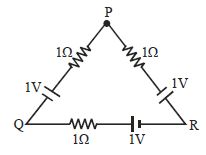
- 5In given circuit find potential difference between $P$ and $Q$ .................. $V$View Solution
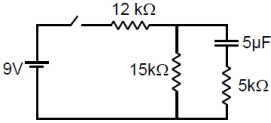
- 6Find charge on the capacitor after $1$ sec of opening the switch at $t=\infty ?$View Solution
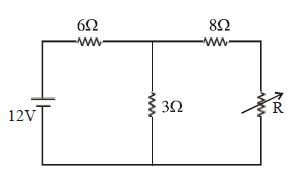
- 7The maximum power delivered to resistance $R$ is ............... $W$View Solution
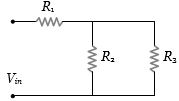
- 8For ensuring dissipation of same energy in all three resistors $({R_1},\,{R_2},\,{R_3})$ connected as shown in figure, their values must be related asView Solution
- 9View SolutionAccording to Joule's law, if the potential difference across a conductor having a material of specific resistance remains constant, then the heat produced in the conductor is directly proportional to
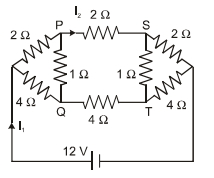
- 10For the resistance network shown in the figure, choose the correct option$(s)$. $Image$View Solution
$(A)$ The current through $P Q$ is zero.
$(B)$ $I_1=3 A$.
$(C)$ The potential at $S$ is less than that at $Q$.
$(D)$ $I _2=2 A$.